Archive

Archive for the ‘chytridiomycosis’ Category

Breeding Panamanian Golden Frogs at the Smithsonian’s National Zoo

June 23rd, 2011 No comments

Smithsonian’s National Zoo biologist Matt Evans talks about what it’s like to care for Panama’s national animal.

Chytrid spreading fast and furiously

June 15th, 2011 No comments

This week we broke the news that chytridiomycosis, a rapidly spreading amphibian disease, has reached a site near Panama’s Darien region, leaving us little time to save the species there at risk of extinction. Here’s an updated map of how the pathogen is moving through the neotropics:

Chytrid spread
Chytridiomycosis has been linked to dramatic population declines or even extinctions of amphibian species worldwide. Within five months of arriving at El Cope in western Panama, chytridiomychosis extirpated 50 percent of the frog species and 80 percent of individuals.

Conservationists have been fretting for years about what might happen to Eastern Panama’s 120-odd amphibian species when chytrid hits. Chytrid is a disease that cannot tolerate extremely hot temperatures, so it tends to be most devastating in cooler mountainous regions of the tropics that remain cool and moist year-round. The mountainous regions of Eastern Panama are one of the last remaining strongholds of naïve amphibian populations in the New World, and species that tend to have a highland distribution and small ranges are the most vulnerable to extinction.

Press release: Smithsonian Scientists Find Deadly Amphibian Disease in the Last Disease-free Region of Central America

June 13th, 2011 No comments
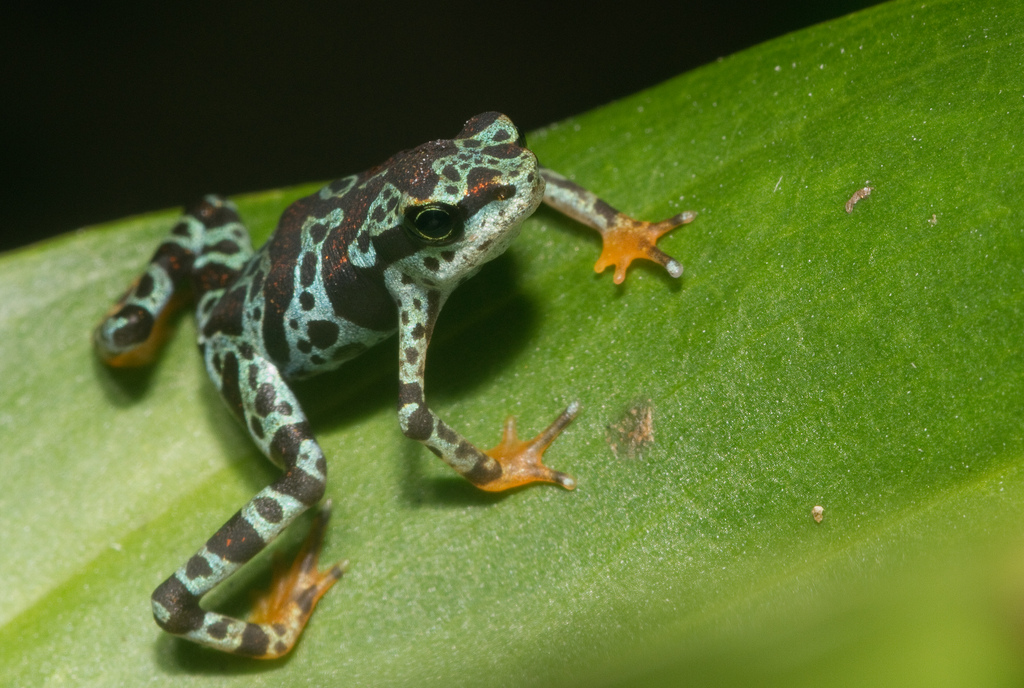
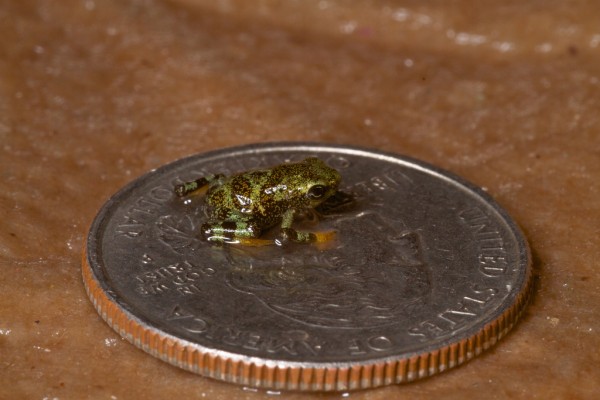
Toad Mountain harlequin frog (Atelopus certus)

The Panama Amphibian Rescue and Conservation Project has established an assurance colony for two species endemic to the Darien, including the Toad Mountain harlequin frog (Atelopus certus), shown here. (Brian Gratwicke, Smithsonian Conservation Biology Institute)

Smithsonian scientists have confirmed that chytridiomycosis, a rapidly spreading amphibian disease, has reached a site near Panama’s Darien region. This was the last area in the entire mountainous neotropics to be free of the disease. This is troubling news for the Panama Amphibian Rescue and Conservation Project, a consortium of nine U.S. and Panamanian institutions that aims to rescue 20 species of frogs in imminent danger of extinction.

Chytridiomycosis has been linked to dramatic population declines or even extinctions of amphibian species worldwide. Within five months of arriving at El Cope in western Panama, chytridiomychosis extirpated 50 percent of the frog species and 80 percent of individuals.

“We would like to save all of the species in the Darien, but there isn’t time to do that now,” said Brian Gratwicke, biologist at the Smithsonian Conservation Biology Institute and international coordinator for the Panama Amphibian Rescue and Conservation Project. “Our project is one of a few to take an active stance against the probable extinction of these species. We have already succeeded in breeding three species in captivity. Time may be running out, but we are looking for more resources to take advantage of the time that remains.”

The Darien National Park is a World Heritage site and represents one of Central America’s largest remaining wilderness areas. In 2007, Doug Woodhams, a research associate at the Smithsonian Tropical Research Institute, tested 49 frogs at a site bordering the Darien. At that time, none tested positive for the disease. In January 2010, however, Woodhams found that 2 percent of the 93 frogs he tested were infected.

“Finding chytridiomycosis on frogs at a site bordering the Darien happened much sooner than anyone predicted,” Woodhams said. “The unrelenting and extremely fast-paced spread of this fungus is alarming.”

The Panama Amphibian Rescue and Conservation Project has already established captive assurance colonies in Panama of two priority species endemic to the Darien—the Pirre harlequin frog (Atelopus glyphus) and the Toad Mountain harlequin frog (A. certus). In addition, the Smithsonian’s National Zoo maintains an active breeding program for the Panamanian golden frog, which is Panama’s national animal. The Panamanian golden frog is critically endangered, according to the International Union for Conservation of Nature, and researchers have not seen them in the wild since 2008.

Bd infection

Chytridiomycosis is a rapidly spreading amphibian disease that attacks the skin cells of amphibians (shown here) and is wiping out frog species worldwide. (Doug Woodhams, Smithsonian Tropical Research Institute)

“We would like to be moving faster to build capacity,” Gratwicke said. “One of our major hurdles is fundraising to build a facility to house these frogs. Until we jump that hurdle, we’re limited in our capacity to take in additional species.”

Nearly one-third of the world’s amphibian species are at risk of extinction. While the global amphibian crisis is the result of habitat loss, climate change and pollution, chytridiomycosis is at least partly responsible for the disappearances of 94 of the 120 frog species thought to have gone extinct since 1980.

“These animals that we are breeding in captivity will buy us some time as we find a way to control this disease in the wild and mitigate the threat directly,” said Woodhams, who was the lead author of a whitepaper Mitigating Amphibian Disease: strategies to maintain wild populations and control chytridiomycosis. This paper, published in Frontiers in Zoology, systematically reviews disease-control tools from other fields and examines how they might be deployed to fight chytrid in the wild. One particularly exciting lead in the effort to find a cure is that anti-chytrid bacteria living on frog skin may have probiotics properties that protect their amphibian host from chytrid by secreting anti-fungal chemicals. Woodhams recently discovered that some Panamanian species with anti-chytrid skin bacteria transmit beneficial skin chemicals and bacteria to their offspring. The paper, Social Immunity in Amphibians: Evidence for Vertical Transmission of Innate Defenses, was published in Biotropica in May.

“We are all working around the clock to find a cure,” Gratwicke said. “Woodhams’ discovery that defenses can indeed be transferred from parent to offspring gives us hope that if we are successful at developing a cure in the lab, we may find a way to use it to save wild amphibians.”

The Smithsonian Conservation Biology Institute serves as an umbrella for the Smithsonian Institution’s global effort to understand and conserve species and train future generations of conservationists. Headquartered in Front Royal, Va., SCBI facilitates and promotes research programs based at Front Royal, the National Zoo in Washington, D.C., and at field research stations and training sites worldwide.

# # #

Media only: contact Lindsay Renick Mayer, Smithsonian’s National Zoo, 202-633-3081

Cute in any form.

May 30th, 2011 No comments
Limosa harlequin frog (Atelopus limosus)

Highland color-form of the Limosa harlequin frog (Atelopus limosus)

Cute Frog of the Week: May 30, 2011

Camouflaged among the moss-covered rocks in the highlands and lowlands of Panama, the Limosa harlequin frog (Atelopus limosus) is difficult to spot even with its yellow clinging toes. These green-and-black-eyed amphibians leave their superb hiding places during the dry season and make their way to the fast-flowing streams of the Panamanian rainforest. Females lay their eggs in streambeds, where eager males wait to fertilize them. Laying clutches of eggs in faster-flowing waters may seem treacherous for the tiny frogs, but they brave the risk. Eggs that are laid in those areas of streams are less likely to be preyed upon, or to face competition from other frog species.

Limosa harlequin frog (Atelopus limosus)

Lowland color-form of the Limosa harlequin frog (Atelopus limosus)

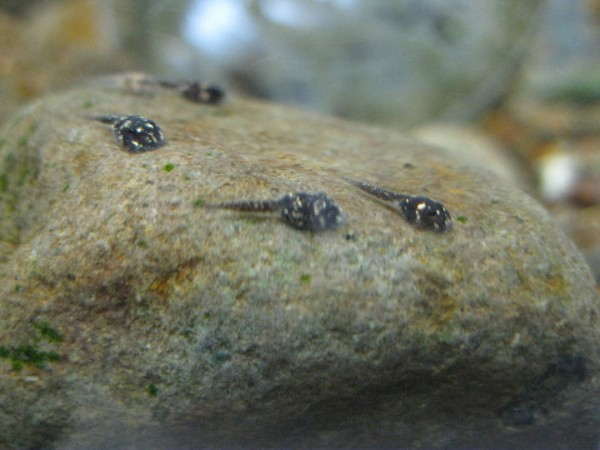
Limosa harlequin frog tadpoles are not left to be swept away by hurried streams once they hatch. Suction disks on their bellies help anchor them to the rocks in the streambeds. However, the species seems to be losing its grip in its fight to survive. It is listed as endangered in the wild and the population is still decreasing. It is facing threats ranging from deforestation to pollution. Those threats are compounded by the ravaging affects of the chytrid fungus.  The Panama Amphibian Rescue and Conservation Project has brought the Limosa harlequin frog into captivity and is learning how to successfully breed them, giving hope for the survival of the species.

Photo credit: Brian Gratwicke, Panama Amphibian Rescue and Conservation Project

Every week the Panama Amphibian Rescue and Conservation Project posts a new photo of a cute frog from anywhere in the world with an interesting, fun and unique story to tell. Be sure to check back every Monday for the latest addition.

Send us your own cute frogs by uploading your photos here: http://www.flickr.com/groups/cutefrogoftheweek/

This time, it is not good to be a leader

May 18th, 2011 No comments
Atelopus varius

Atelopus varius is just one of many species of frog that is critically endangered. (Photo by Brian Gratwicke, Panama Amphibian Rescue and Conservation Project).

Chytrid fungus is believed to have played a role in the disappearance of 94 of the 120 frog species thought to have gone extinct since 1980.  But that is not the only battle frogs are facing in the fight to survive.

No one issue can explain all of the population declines that are occurring at an unprecedented rate, and much faster in amphibians than most other animals, the scientists conclude in a study just published in the Annals of the New York Academy of Sciences.

The totality of these changes leads these researchers to believe that the Earth is now in a major extinction episode similar to five other mass extinction events in the planet’s history. And amphibians are leading the field – one estimate indicates they are disappearing at more than 200 times that of the average extinction rate.

In this case, it is not good to be the leader.

Cindy Hoffman, Defenders of Wildlife

A sad story with a golden glimmer of hope

May 2nd, 2011 No comments

Panamanian golden frog (Atelopus zeteki)

Cute Frog of the Week: May 2, 2011

Critically endangered since 2004, the endemic Panamanian golden frog has suffered a population decline of 80 percent over the last 10 years. An angular, dark yellow frog with a trademark swagger, the golden frog is a symbol of Panama’s abundant biodiversity. It is also well-known for its potent skin toxins, which it uses to protect itself against predators. A single frog’s skin contains enough nerve-disabling poison to kill 1,200 mice! Frequently found in and around high mountain forest streams, the golden frog in its golden-yellow, liberally spotted morph (individuals come in various colors and patterns) visually warns potential predators to stay away.

Despite its toxicity, the frog has found itself nearly defenseless against chytridiomycosis, the amphibian disease epidemic that has recently devastated frog populations and biodiversity throughout Central America. Because the range of this frog species is limited, extinction seems all too likely, unless human intervention succeeds in keeping the species around in captivity. Fortunately, an in-situ conservation program in western Panama (the El Valle Amphibian Conservation Center, aptly named EVACC) has led the conservation effort as part of the Panama Amphibian Rescue and Conservation Project.

Frog declines raise a number of fascinating questions.  For example, recent studies have shown that Panamanian golden frogs are making a last-ditch attempt to ward off infection by thermally killing the pathogen. Fortunately, researchers believe that the chytrid fungus does not thrive at temperatures 5 C above the frog’s normal body temperature. The frog attempts to increase its body temperature above normal levels by moving within its habitat to warmer places. As an ectotherm (a cold-blooded animal), the frog can only control its internal temperature by these behavioral adjustments to its external environment. Nonetheless, these efforts by wild golden frog populations may by in vain. Chytridiomycosis has so far prevailed, but intense conservation efforts in Panama keep hope alive. Panama’s symbol of amphibian beauty continues to awe humans in safe environments like EVACC. Re-introduction of these individuals and any offspring into the wild will, we are assured, only take place if and when the epidemic has abated.

Photo credit: Mehgan Murphy, Smithsonian’s National Zoo

Every week the Panama Amphibian Rescue and Conservation Project posts a new photo of a cute frog from anywhere in the world with an interesting, fun and unique story to tell. Be sure to check back every Monday for the latest addition.

Send us your own cute frogs by uploading your photos here: http://www.flickr.com/groups/cutefrogoftheweek/

Q&A with EVACC’s Frog Heroes

March 24th, 2011 No comments
Heidi Ross and Edgardo Griffith

Heidi Ross and Edgardo Griffith run a facility in Panama that is a safe haven for more than 60 species of frogs. (Photo by: Lindsay Renick Mayer, Smithsonian's National Zoo)

Last fall I had the privilege to spend some time at the El Valle Amphibian Conservation Center (EVACC) in El Valle, Panama. At the time I described it as a frog lover’s heaven. It is also an impressive safe haven for Panama’s national animal, the Panamanian golden frog, and about 60 other struggling species. I had an opportunity to sit down with both Edgardo Griffith and Heidi Ross, who run EVACC, and here is some of what these frog heroes had to say about their important work.

What is EVACC’s role in the Panama Amphibian Rescue and Conservation Project?

Edgardo Griffith, Director of EVACC: Our role is to be part of the whole conservation effort. In the beginning, we were all working separately. In Panama City especially, there wasn’t much going on in the way of amphibian conservation. Fortunately, the National Zoo and our other partners, such as the Houston Zoo, were also alarmed by the fact that so many amphibians were disappearing because of this chytrid fungus. Now that EVACC is involved with the Panama Amphibian Rescue and Conservation Project, we can make an even bigger effort toward amphibian conservation. It’s also encouraging for people to see that an international group of people are working toward the amphibian conservation of our country. What we focus on here at EVACC is identifying a group of species that we know, if we don’t do something now, they will go extinct. They go on our priority list. We find those species and bring them to our facility to study and care for them and provide a safe and comfortable breeding environment.

How did you get involved with amphibian conservation?

Heidi Ross, Associate Director of EVACC: I first came to Panama in 2000 with the Peace Corp. and worked with them for four years. I started doing volunteer work on the weekends and surveying for frogs, which is when I met Edgardo. I had studied biology in college at Luther but to go out into a tropical rainforest at night and see these frogs was unbelievable. After that, I started going out more and more to learn about the frogs in Panama.

Edgardo: After 3 ½ years of studying biology and parasitology at the University of Panama, I got invited to go to the field and look for snakes and frogs for a field seminar. I wasn’t really happy about that. I didn’t want to go in to the jungle at night. It’s wet, dark, dangerous… You just don’t do that! I was just a normal student living in Panama City so that did not sound like fun to me. But thank god I got convinced to go. When I started finding all the different frogs, it was amazing. I had never seen anything like it and the habitat was just so beautiful. I fell in love.

What is it about frogs that make them so special?

Golden frogs at EVACC

EVACC is the only place in Panama where the country's national animal, the Panamanian golden frog, exists. (Photo by: Lindsay Renick Mayer, Smithsonian's National Zoo)

Heidi: Because they’re the coolest! I’m from Wisconsin and never really thought twice when I would see a frog outside or in my yard, but once you come to the tropics, it changes everything. The diversity here is just so enormous! You can see the frogs’ hearts beating, hear different calls, see how they utilize and manipulate their habitat. It amazes me that there are species upon species here and they all share the same space and work together. We could learn from them.

Edgardo: If you want to see an animal that really identifies a place or a healthy environment, find a frog or an amphibian because they are so sensitive to environment change or pollution. From a biology perspective, that’s a huge reason to love and appreciate frogs.

How does it feel to see these amphibian populations declining and disappearing?

Edgardo: I cannot quite describe the feeling of going to the field and not finding what you’re used to finding. You still see the rocks covered with green moss and the insects in the clear water, but you don’t see the animals that, in my mind, identify these beautiful places, that make these places perfect. You don’t see the amphibians anymore. It’s sad and it feels a little unfair. I’ve been dealing with amphibian declines since 1999. You go into the field and see the amphibian population during the summer, then you go the next year and see nothing. Your animal friends that you love and appreciate are not there any more. It’s very upsetting. Even worse, this chytrid fungus could potentially be wiping out species we have yet to even discover. And this is happening to amphibians worldwide, not just in Panama.

Heidi: To not see frogs in a stream where you know they used to be… It’s anger, frustration, sadness. A species is gone. It’s not something that’s easy to deal with, especially after you’ve invested so much in caring for and protecting these animals.

Can you describe what it’s like to take care of the amphibians at EVACC?

Heidi: It can be very challenging. We’re trying to replicate Mother Nature, but she’s pretty good at what she does. It’s so much more than just dangling a cricket in their tank, which I think a lot of people think we do. We have to check the water temperature and quality and make sure the pH levels are balanced; plants and everything have to be clean. There are so many things to do in each tank. Ultimately, we’re not breeding frogs, frogs are breeding frogs. We’re just trying to provide conditions where they feel comfortable doing what they need to do.

Panamanian golden frog

The Panamanian golden frog once lined the streams in El Valle during the rainy season, but is now extinct in the wild. (Photo by: Mehgan Murphy, Smithsonian's National Zoo)

Edgardo: Taking care of amphibians is an art. You have to treat each animal as an individual and use special care, especially when you know that this animal may be the last of its kind. It’s overwhelming at first to know that you’re dealing with such an important species, so you have to be careful. If you stress out, the animals can feel it, and it makes them nervous too. Although it’s a lot of work, it’s very rewarding when we hear the males calling out, not because of stress, but to the females, and they’re ready to breed. We want them to be comfortable and engage in those natural breeding behaviors.

What is it like to discover a new species?

Edgardo: It’s always exciting and feels very rewarding. You’re out there working all day and night in the streams and then you see something that you’re not familiar with. It’s always exciting when that happens. We have a lot of new species that still need to be described because it’s quite a lengthy process. And we have to be quick about it. I found a new frog in 2005 and we got the papers out in 2007. By that time, the frog was already gone, disappeared for good.

What message would you give to the public about amphibian conservation?

Edgardo: Panamanians, especially, love the Panamanian golden frog. It is a symbol of our country. There used to be golden frogs everywhere, in the streams, being sold on the streets for 50 cents. Now the only golden frogs left in Panama live at EVACC. There are no more. I think this should say something to the people of Panama who love this frog so much. We need help. If we want to protect this beautiful symbol of our country, along with thousands of other species, we need help.

Heidi: We owe it to our planet, if we can do something to help, we should do something. Whether you like it or not or don’t even know what it is. We owe it to our planet to maintain biodiversity.

-Lindsay Renick Mayer, with help from Lexie Beach, Smithsonian’s National Zoo

Science Project: A Cure for Chytrid

March 9th, 2011 5 comments

The author with Brian Gratwicke at the SCBI autumn conservation festival

One autumn day in 2010, I was at the Smithsonian Conservation Biology Institute, (SCBI) and I met Brian Gratwicke. Brian is a frog expert, a herpetologist, and is working in Panama to save frogs from a deadly fungus. The fungus is called chytridiomycosis, or chytrid. Brian told me of one cure for the chytrid fungus. It is a bacterium, called Janthinobacterium lividum. J. liv. for short. He said that the cure can come off the back of some redback salamanders, (Plethodon cinereus) which I realized, live in my back yard in northern Virginia. He said that it was kind of rare to discover the salamanders that have the bacteria on them. You need to swab the salamanders, and streak the bacteria on their backs onto agar plates. He said that if the salamanders carry J. liv., a milky purple spot will appear on the plate, that you can’t miss it. I told him I am very interested in herpetology, and that I could the do the experiment by the winter. So that is when I decided to try and find Janthinobacterium lividum. Brian said it was a great idea, but he would be very surprised if I found J. liv.

Searching for chytrid cure on the backs of salamanders - Tommy's 6th grade science fair project

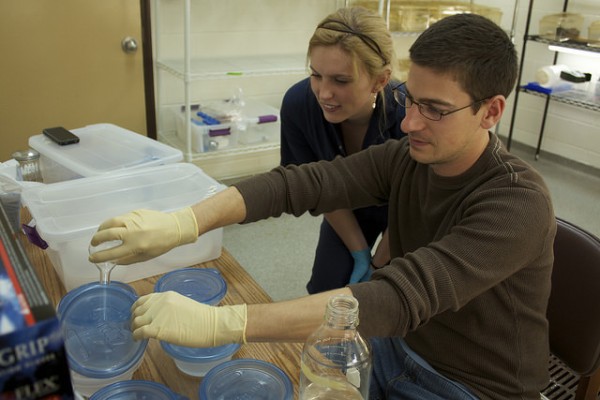
I started with a question. My question was; is J. liv really on the backs of the redback salamanders in my backyard? To perform the experiment, I needed some supplies. I got petri dishes, agar, sterile swabs, distilled water, gloves, a plastic terrarium, my camera, and an instruction book (on how to prepare and streak petri dishes). Soon I had my lab set up. I microwaved the agar until it was completely liquid. Then I carefully lifted up the lids of the petri dishes, and poured the liquid agar in. I labeled them from one to ten. I put my gloves on, and got the terrarium. I was ready to catch some salamanders.

Isolating Janthinobacterium lividium with a sterile swab

Isolating Janthinobacterium lividium with a sterile swab

Soon I was outside on the lookout for anything that was small, and that crawled. I went to my backyard and started looking. I looked under logs, rocks, and bricks. After many false alarms with large earthworms, I came across a redback salamander. I picked it up with my gloves, and put it in my terrarium. Then I ran back inside. I set down the terrarium and began my work. I used my supplies to swab the salamander, and photograph it. I then returned it to its log, and started looking for another salamander. After the next few weeks of hard looking, I had done this for all my ten of my petri dishes, with salamanders, collected from different locations. I just needed to wait for the bacteria to grow. I waited for about three days. By then, the color started to appear on the petri dishes. On dish number one, there were orange and clear colors, but no purple. It was the same for all the next eight. On petri number ten, things were different. It took much longer to culture bacteria on it.

Pure cultures of purple bacteria, the purple comes from the anti-fungal chemical violacein.

Pure cultures of purple bacteria, the purple comes from the anti-fungal chemical violacein.

After three additional days, I saw it. In a small spot in the middle of the petri dish, was a milky purple spot. I couldn’t believe what I was seeing. I had found the bacteria. I took photos of all the petri dishes, and wrote the dates that the color appeared on them. I took many photos of the purple J. liv. colony. I was so happy.

It was very lucky that I had found J. liv. After I found the bacteria, I bought two more petri dishes. I took the original J. liv. culture and swabbed it. I then streaked the new agar plates with J. liv. I waited. Within three days, the color started to appear. The whole agar plates were covered in the milky purple J. liv. I wrote down my observations. I could culture and grow J. liv. in gigantic amounts. I found Janthinobacterium lividum, and I was proud of myself. I couldn’t wait to tell Brian Gratwicke!

–Tom McCarthy, 6th grade Chesterbrook Elementary School in McLean VA.

In the Field, In Search of a Cure

March 2nd, 2011 No comments
Rocket frog with tadpoles

Researcher Denise Küng is using emerald glass frogs and rocket frogs (shown here with tadpoles) in Panama to see if she can develop a treatment for chytrid. (Photo by Brian Gratwicke, Panama Amphibian Rescue and Conservation Project)

What comes to your mind when you think about bacteria? They are generally feared as disease agents among humans, but they do much more than cause infections. It seems like mutualistic microbial communities are common in invertebrates as well as vertebrates. Humans, with more than 600 types of bacteria residing only in their mouth, are no exception. Several cooperating bacteria can develop biofilms and create a matrix of living cells and bacterial products, and the community structure of microbes on a host could be connected with resistance to disease. Let’s say a bacterial community is disturbed by antibiotics and its competitiveness is thus reduced, then pathogens can exploit this and establish themselves in a host.

The skin of amphibians is host to a diverse microbiota. They live in damp or aquatic habitats which are potentially pathogen-rich environments. As protection against infections, amphibians developed skin defenses, such as antimicrobial peptides secreted by glands in their skin and microbial communities with antimicrobial activity. By doing bacteria removal and additional experiments, scientists found evidence for enhanced or decreased amphibian health depending on alterations of the microbial community structure on the skin. In some amphibian species, antimicrobial peptides seem to provide protection from infectious diseases such as the fungus Batrachochytrium dendrobatidis and may help to prevent population declines.

Denise with Colostethus

Denise hopes to find a treatment for frogs in nature so they can safely coexist with chytrid. (Photo by Brian Gratwicke, Panama Amphibian Rescue and Conservation Project)

To find out more about the bacterial communities and antimicrobial peptides on the skin of amphibians, I’m currently in Panama working with the Panamanian rocket frog, Colostethus panamensis, and emerald glass frog, Centrolene prosoblepon. I’m going to look at their skin microbiota and how it changes after several weeks living in captivity. Will it stay the same or are some members of the bacterial community getting lost?

By giving some of the rocket frogs a bath in a solution with bacteria, I’m trying to increase the density of a particular bacterium on their skin. This bacterium has been shown to decrease the growth of the chytrid fungus Batrachochytrium dendrobatidis in the lab. If it’s possible to amplify its density on amphibian skin over a long period of time, this might be a possible treatment for frogs in nature to allow them to coexist with the pathogen in infected environments.

The emerald glass frogs seem to be able to survive in environments infected with Batrachochytrium dendrobatidis. They must have found a form of protection from the fungus on their skin. I am taking a closer look at the antimicrobial peptides on their skin. I also bathed them in water every day for a week and then used their skin washes to treat another group of the rocket frogs with the hope that whatever protects the glass frogs from the fungus will go in the water and from there onto the skin of the rocket frogs. Analyzing the skin swabs of the frogs in the lab will show whether this treatment changed the rocket frog skin microbiota, antimicrobial petides or both.

Denise Küng, University of Zurich

Categories: chytridiomycosis, Extinction, Rescue Tags:

Cheyenne Mountain Zoo Finds Endangered Frog In The Jungles of Panama

February 26th, 2011 No comments
Limosa Harlequin Frog

Limosa Harlequin frog. Photo B. Gratwicke, Smithsonian Institute

A Cheyenne Mountain Zoo team led by President Bob Chastain is back in Colorado after spending nine days in the jungles of Panama as part of a global effort to save amphibian species on the verge of extinction due to chytrid fungus. The team was searching for the endangered Atelopus limosus harlequin frog, and collected one female, two males, and a juvenile (sex to be determined). Until this trip, there was just one Atelopus limosus female and four males in captivity in the world. The female found by the team is especially important in creating a viable, sustainable population.

“I saw first-hand how grave the situation is, and it’s sobering,” said Chastain. “But there’s no time for despair. There’s work to be done and we have to dig in. As Americans, we are no strangers to digging in and dealing with monumental problems.”

Over one-third of the world’s amphibians are threatened with extinction. The rapidly spreading chytrid fungus is taking a huge toll, wiping out 30% – 50% of species in its path, species which could hold the key to significant medical advances against HIV, cancer, and other diseases.

“The forest is getting quieter and quieter,” said Chastain. “During our first trip in November of 2009, the sound of frogs was almost deafening. That’s not the case anymore.”

This was the fifth expedition for Cheyenne Mountain Zoo. The team of five spent as many as 13 hours a day hiking the remote, mountainous area of Cerro Brewster looking for the Atelopus limosus, a half-dollar-sized frog that blends in with the dark rocks and green moss. The only tools at their disposal were walking sticks to move leaves and rocks.

“It’s like looking for a needle in a haystack,” said Chastain.

When a specimen was found, the team swabbed the frog to check for chytrid. Each frog was then placed in a plastic bag and transported to a bio-secure breeding facility at Panama’s Summit Zoo, where another Cheyenne Mountain Zoo staffer assisted with veterinary care.

“We’re seeing entire populations go extinct before our eyes,” said Chastain. “By finding these frogs and treating them, we’re at least giving them a chance at survival. In the words of ecologist Aldo Leopold, to keep every cog and wheel is the first precaution of intelligent tinkering.”

Cheyenne Mountain Zoo hopes by getting involved before amphibians are gone forever, future generations of scientists will have the resources necessary when it comes to curing environmental disasters and making medical history.

Cheyenne Mountain Zoo is a founding partner in the international Panama Amphibian Rescue and Conservation Project initiative. The organization’s mission is to establish amphibian assurance colonies and develop methodologies to reduce the impact of the chytrid fungus so captive amphibian species may one day be re-introduced to the wild. Cheyenne Mountain Zoo was joined this trip by representatives from other Panama Amphibian Rescue and Conservation Project partners, including Houston Zoo’s El Valle Amphibian Conservation Center (EVACC), Smithsonian Tropical Research Institute, and Summit Zoo. Zoo New England oversaw the veterinary support. Africam Safari, ANAM (Autoridad Nacional del Ambiente), Defenders of Wildlife, and Smithsonian’s National Zoological Park also fund and provide support for the project.

WATCH THE VIDEO INTERVIEW HERE

Katie Borremans, Cheyenne Mountain Zoo