Archive

Archive for the ‘why frogs matter’ Category

Smithsonian scientists survey frogs in the Peruvian Andes

March 28th, 2012 No comments
Acancocha water frog (Telmatobius jelskii)

Last December two researchers from the Smithsonian Conservation Biology Institute spent two weeks in Peru surveying the Acancocha water frog (Photo by Jessica Deichmann, SCBI)

Imagine measuring the tail of a squirmy, inch-long tadpole. Now imagine doing that where the air is thin enough to make you dizzy, a hail storm is about to start and you just spent 45 minutes up to your elbows in a freezing cold stream.

Last December, Jessica Deichmann, a research scientist with the Smithsonian Conservation Biology Institute, and Ed Smith, a biologist at the Smithsonian’s National Zoo’s Amazonia Exhibit, spent two weeks doing just that to complete a survey of the Acancocha water frog (Telmatobius jelskii). They were participating in a frog surveying trip for SCBI’s Center for Conservation Education and Sustainability’s Peruvian Biodiversity Monitoring and Assessment Program (BMAP). The program lends Smithsonian scientific expertise to gas and oil companies to assess the effects of development projects on local plants and animals. This information is used to improve restoration work, and reduce environmental impacts of future development. This was the third survey along the path of a natural gas pipeline constructed in 2009 that runs from the Amazon over the Andes to the Pacific Ocean—about 250 miles.

The Acancocha water frog is found only in the cold clear streams of the high-elevation Peruvian Andes. The frog is one of about 40 species researchers are surveying around the construction of this particular pipeline. Scientists chose this species because although historically it has been fairly abundant, it lives in a relatively small area with precise habitat requirements. When individuals of a species are clustered together, it’s easier to lose the entire species.

“You always worry about frogs with small geographic ranges—not just frogs, but any species,” Deichmann said.

When you think of the Peruvian Andes, you probably think of Macchu Picchu, a lush green mountainside where, as Smith jokes, “if you sit too long you have orchids growing on you.” Smith and Deichmann, however, were in a very different ecosystem called puna and sometimes nicknamed equatorial tundra. Puna is found high in the Andes, where trees no longer grow, rain is scarce, and nights are freezing. The team spent much of its time about 15,000 feet above sea level, where the air is so thin that breathing is hard until you get used to it. “For us lowland landlubbers, that alone was an exhausting business,” Smith said.

Peruvian Andes

Smith and Deichmann were in a very different ecosystem called puna and sometimes nicknamed equatorial tundra. (Photo by Jessica Deichmann, SCBI)

The team—Deichmann, Smith and two Peruvian biologists—took samples at twelve sites where the pipeline crosses mountain streams. At each site, they spent about 45 minutes upstream, elbow-deep, feeling for frogs and tadpoles. For each tadpole, first, the team swabbed its mouth for a sample for chytrid testing. The team also recorded the tadpole’s body length, tail length, mass, and developmental stage, and photographed each sample before the animal was returned to the stream.  They also took measurements of the stream itself. Then the team repeated the whole process downstream of the pipeline. Any one site could take five or six hours.

But Deichmann is clear that the process was worth it. “Just to find frogs and tadpoles was exciting,” she said. “Especially adults—after hours and hours in freezing cold water and your arms are purple, when you find your first frog it’s just so exciting.”

The team hasn’t processed the data yet, but their initial measurements suggest some good news: so far, they have seen no obvious effects as a result of the pipeline. However, although the team found hundreds of tadpoles, they found only 10 adult frogs in all the sample areas.

Unfortunately, that suggests chytrid is playing a role in shaping the population structure. The skin fungus follows skin keratin proteins, the amphibian equivalents of those found in human skin calluses, hair and nails. Tadpoles usually survive chytrid infection because they have keratin only around their mouths. As they develop their keratin “suit of armor,” frogs are left vulnerable to the disease that has decimated them in less than half a century.

“From metamorphosis, something called the ‘chytrid clock’ starts ticking,” Smith said. In adults, “chytrid interferes with water balance, usually in a lethal way.” Because of this, chytrid-struck populations often consist of many tadpoles and a few adults.

And according to the previous surveys, “at pretty much all the sites where frogs and tadpoles were present, chytrid was present,” Deichmann said.

Mountain stream

At each of 132 sites, the team spent about 45 minutes upstream, elbow-deep, feeling for frogs and tadpoles. (Photo by Jessica Deichmann, SCBI)

But until they have the results from lab tests on the mouth swabs the team took, they won’t have the full picture about how the disease is affecting these populations.  And chytrid isn’t the only danger these frogs face. “In a lot of our streams we were, not surprisingly but disappointingly, finding trout,” an invasive predator, Smith said.

Deichmann and Smith agree that the data they collected will be useful for conservation efforts. “Monitoring populations now gives us a baseline without which we can never know what’s changed,” Smith said. The team has a tentative follow-up survey scheduled for the dry season of 2012, during the northern hemisphere’s summer. Deichmann hopes that the data from this December’s trip will allow the program to modify the survey protocol to make sure future trips are gathering the most helpful data possible.

And of this expedition? “It was an amazing trip,” Deichmann said. “The habitats are stunning, the scenery is stunning. You’re at the top of the world.”

Meghan Bartels

Frogs and Painted Dogs – A Unique Partnership

March 22nd, 2012 No comments

The rain frogs live most of their lives hibernating under the sand in Southern Africa and also creep rather than hop. Only after heavy rains will they emerge from the earth to eat and to breed. The males are so much smaller than the females they must actually secrete a glue from their abdomen to stick on to the females back and hitch a ride to where she will dig her underground burrow to deposit her eggs! (Photo courtesy of the Houston Zoo)

Frogs and Painted Dogs.  It’s got a nice ring to it.

It might seem unlikely that a conservation organization focused on a large charismatic carnivore would be interested in using frogs and toads to teach students about research, biology and conservation. But amphibians are an indicator species in a habitat in which the painted dog depends on survival and a model organism for teaching taxonomy, biology, adaptations, ecological concepts, environmental threats and how students can implement conservation action.

During a 2010 lecture stop at the Houston Zoo, Dr. Gregory Rasmussen, the director of Painted Dog Conservation (PDC) in Dete, Zimbabwe heard about Toad Trackers, a conservation education program implemented by the Houston Zoo Department of Conservation and Science.

Through specialized classroom training and field experiences, Toad Trackers teaches students the methods wildlife biologists use to study wild animal populations.

Dr. Rasmussen saw the concept as a great fit for PDC’s Iganyana Bush Camp, which teaches local children conservation concepts, ecological relationships and the value of biodiversity.

On November 22, 2011, Houston Zoo Conservation Programs Manager Rachel Rommel and Dr. Cullen Geiselman, a Houston Zoo board member with experience teaching bat workshops and field programs, arrived at Painted Dog Conservation headquarters and began scouting study sites for a new conservation education program – Kids for Science, a pilot program for 14-year-old students.

A teacher holds a bocage

After scouting out potential study sites, Rachel conducted nightly visual and audio searches and documented 16 species of amphibians. Cullen identified the bat species that would be observed with the children during the program. They visited local villages and schools accompanied by PDC education staff creating conservation action plans that would be implemented by teachers and students .

With ideas for community conservation programs and a familiarity with the local fauna, Rachel and Cullen welcomed 11 exceptional and gracious pupils from Nechilibi High School to pilot the first PDC Kids for Science program, an intensive two-day course including class presentations, classroom training activities, field exercises and interactive discoveries.

After learning how biologists detect and monitor animal activity and how scientific information is collected, students spent two evenings in the field, at Hwange National Park and Granda Lodge making observations and assisting teachers, conservation coordinators and a National Park staff member in the capture and data collection of amphibians and bats.

A final project, an amphibian field guide, was assembled by the group to present to their classmates and headmaster.  The students, now community ambassadors for amphibians and bats, are now tasked with creating specific ways their school and club can help in the conservation of insectivores and will report back to PDC this spring.

Resources donated to PDC (bat detectors, spring scales, calipers, calculators, headlamps, field guides and more) will be used to incorporate Kids for Science into the existing education program.

Frogs and Painted Dogs–a unique collaboration advancing conservation efforts of amphibians and bats in Zimbabwe.

–Brian Hill, Houston Zoo

A leap of faith?

March 5th, 2012 No comments
Misfit leaf frog (Agalychnis saltator)

Misfit leaf frog (Agalychnis saltator)

Cute Frog of the Week: March 5, 2012

Just like you get dressed in the morning, the parachuting red-eyed leaf frog or misfit leaf frog (Agalychnis saltator) changes from its nighttime tan or brown to its daytime bright green. But that isn’t the only trick this little guy has up its sleeve. These frogs have lots of webbing between their fingers and toes, and during breeding season males make large leaps with this webbing splayed wide to act as small parachutes.

These little misfits, who live in Nicaragua and Costa Rica, lay their eggs on the moss that covers tree vines during the rainy season. Unfortunately, this makes the eggs particularly vulnerable to becoming a snack for ants and snakes. The frogs that do make it to adulthood, however, are plentiful enough to make this species not at risk of extinction.

Photo by Joe Milmoe, U.S. Fish and Wildlife Service.

Every week the Panama Amphibian Rescue and Conservation Project posts a new photo of a cute frog from anywhere in the world with an interesting, fun and unique story to tell. Be sure to check back every Monday for the latest addition.

Send us your own cute frogs by uploading your photos here: http://www.flickr.com/groups/cutefrogoftheweek/
Leap Day the Frog Way

February 29th, 2012 No comments

The real purpose of leap day may be to keep the calendar aligned with the seasons, but here at the rescue project, we’d like to believe the day is designed to honor our favorite leapers. To celebrate, we’ve put together some fun facts about frog leaping.

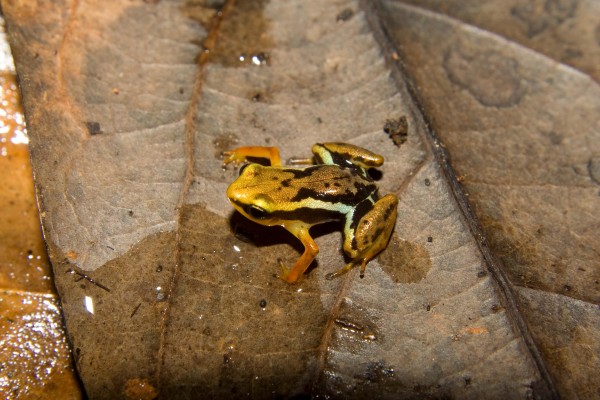
Silverstoneia flotator

Leap day, or Feb. 29, happens nearly every four years. (Image: Rocket frog, Silverstoneia flotator)

  • Not all frogs can leap, or even hop. The desert rain frog (Breviceps macrops) has legs that are too short to hop. Instead, it walks.
  • Male frogs of the genus Pipa are known to defend their territory by jumping at and then wrestling other males.
  • The New Guinea bush frog (Asterophrys turpicola) takes jump attacks one step further: before it jumps at a strange frog, it inflates itself and shows off its blue tongue.
  • Stumpffia tridactyla are normally slow-moving critters, but when they’re startled they can abruptly jump up to 8 inches. That doesn’t sound very far, but these little guys are less than half an inch long!
  • The Fuji tree frog (Platymantis vitiensis) may be the leaping stuntman of the frog world. Each time it leaps, it twists in the air—sometimes even 180 degrees—to throw predators off its trail.
  • The Larut torrent frog (Amolops larutensis) gets its name from a nifty leaping trick: it can jump into a fast-moving stream and back to its usual perch, the underside of a rock, without being affected by the current.
  • Similarly, the parachuting red-eyed leaf frog (Agalychnis saltator) gets its name because it speeds to mating opportunities by jumping from trees with finger-and toe-webbing spread wide.
  • The record for longest jump by an American bullfrog (Rana catesbeiana) recorded in a scientific paper is a little over 4 feet. But scientists who went to the Calaveras County Fair, which Mark Twain’s short story made famous for frog jumping, found that more than half the competitors bested that record—and one jumped more than 7 feet in one leap!
  • The Guinness Book of World Records doesn’t include any frogs for their leaping ability. But it does track human performance in frog jumping (jumping while holding one’s toes). There are records listed for the longest frog jump and the fastest frog jumping over 10 and 100 meters.

In honor of leap day celebrations being coordinated globally by Amphibian Ark, the Panama Amphibian Rescue and Conservation Project made this video for a frog song written by Alex Culbreth.

Meghan Bartels, Smithsonian’s National Zoo

No rainy day blues here.

February 27th, 2012 No comments
Common Chinese frog (Hyla chinensis)

Common Chinese frog (Hyla chinensis)

Cute Frog of the Week: February 27, 2012

You’ll never catch a Chinese tree frog (Hyla chinensis) singing “Rain, rain, go away.” Found in eastern China and Taiwan, these little guys live in shrubs and rice paddies, often in small groups. They are common during the rainy season, but they can be tricky to spot once the weather gets drier. Chinese tree toads only lay their eggs after a rainy April or May evening. Although they could suffer from habitat loss and degradation, their population is currently stable and they benefit from living in several protected areas.

Photo by Tzu-lun Hung via ARKive.

Every week the Panama Amphibian Rescue and Conservation Project posts a new photo of a cute frog from anywhere in the world with an interesting, fun and unique story to tell. Be sure to check back every Monday for the latest addition.

Send us your own cute frogs by uploading your photos here: http://www.flickr.com/groups/cutefrogoftheweek/

Nothing but blue skies.

February 21st, 2012 No comments
Powder blue reed frog (Heterixalus madagasariensis)

Powder blue reed frog (Heterixalus madagasariensis)

Cute Frog of the Week: February 20, 2012

It’s pretty evident that this frog is quite a stunning find. Native to Madagascar, the powder blue reed frog’s color varies from tan to light blue on their backs, and they often appear whitish in bright sunlight. Their abdomens are a very pale whitish-yellow, while the undersides of their limbs are orange. A dark band sits between the eye and snout.

Fairly common, these semi-arboreal frogs prefer to live in a variety of areas ranging from drier sandy lowland dunes/forests and along rainforest edges, to deforested areas around croplands, villages and more urban habitats along the eastern coast of the island.

These are small and agile frogs that can jump over a large distance, though they tend to sleep for most of the day among vegetation.

Photo by Gonçalo M. Rosa via ARKive.

Every week the Panama Amphibian Rescue and Conservation Project posts a new photo of a cute frog from anywhere in the world with an interesting, fun and unique story to tell. Be sure to check back every Monday for the latest addition.

Send us your own cute frogs by uploading your photos here: http://www.flickr.com/groups/cutefrogoftheweek/
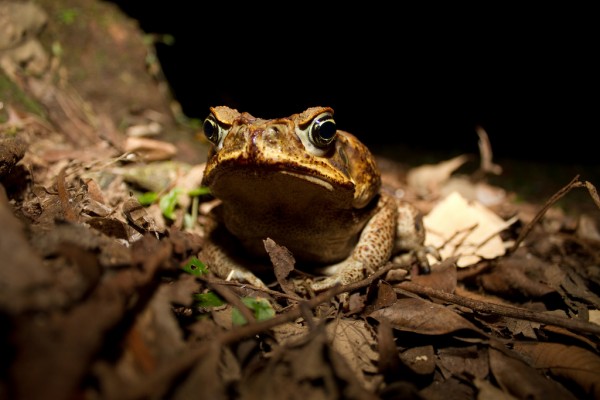
You say “tomato;” I say “Wait! Don’t eat me!”

February 13th, 2012 No comments
Tomato frog (Dyscophus antongilii)

Tomato frog (Dyscophus antongilii)

Cute Frog of the Week: February 13, 2012

It’s easy to see how the tomato frog got its name, considering its eye-catching coloration and relatively large size. Males tend to be yellow-orange in color and grow to around 2.3 – 2.6 inches in length, while females are a brighter orange-red and can grow to be around 3.3 – 4.2 inches in length.

Originally from Madagascar, these frogs are a favorite of tourists and locals alike, especially in the town of Maroantsetra. Here, they inhabit gardens, ponds and ditches. The locals refer to their low-pitched call as the onomatopoetic word “sangongon,” with the word spoken aloud sounding similar to the actual call itself.

But don’t try to pick one up! These frogs are known for their sticky skin secretions that they can release when frightened. This substance gets into a potential predator’s eyes and mouth, making it very difficult to hold onto and eat the frog. It also contains a toxin that can cause skin irritation in humans. In addition to secreting yucky goop, these frogs puff themselves up when a predator comes around to make themselves even more difficult to hold onto and swallow.

This species has been listed as near-threatened since 2002 since it lives in a relatively small area, but adapts well to disturbed habitats. Pollution and pesticide use are potential threats, as well as people harvesting and collecting them for trade, which they are no longer allowed to do. Now, most tomato frogs kept as pets by experienced enthusiasts were bred in captivity.

Photo by Gonçalo M. Rosa via ARKive.

Every week the Panama Amphibian Rescue and Conservation Project posts a new photo of a cute frog from anywhere in the world with an interesting, fun and unique story to tell. Be sure to check back every Monday for the latest addition.

Send us your own cute frogs by uploading your photos here: http://www.flickr.com/groups/cutefrogoftheweek/
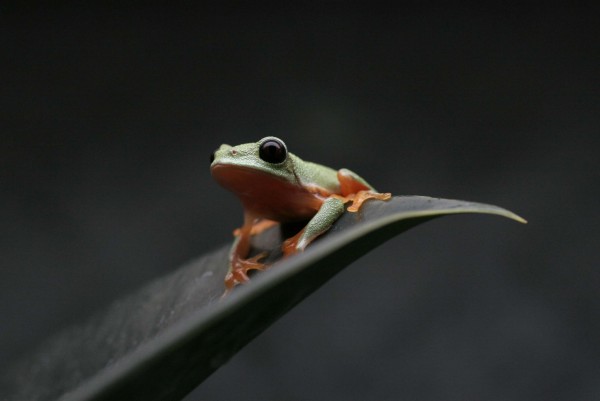
National Zoo Successfully Collects Sperm Samples to Save Endangered Frog

February 9th, 2012 8 comments
Gina Della Togna, an SCBI PhD student and native Panamanian, is one of the researchers in charge of the sperm collection procedure.

Gina Della Togna, an SCBI PhD student and native Panamanian, is one of the researchers in charge of the sperm collection procedure. (Photo courtesy of the Smithsonian Conservation Biology Institute)

With nearly one-third of all amphibian species at risk of extinction as the result of the deadly chytrid fungus, the Smithsonian’s National Zoo has taken a bold step toward preserving amphibian genes and the world’s incredible amphibian biodiversity. Researchers at the Smithsonian Conservation Biology Institute in Washington, DC, have begun to collect sperm samples from the Zoo’s collection of Panamanian golden frogs (Atelopus zeteki), which are extinct in the wild.

Although researchers have collected sperm samples from other amphibian species such as Mississippi gopher frogs and leopard frogs, there are no publications detailing sperm collection methods from Panamanian golden frogs. SCBI’s colleagues at the Maryland Zoo have aided in the process, providing advice to the SCBI researchers about the method to collect the frogs’ spermatozoa using hormonal stimulations.

“We currently have three other species of Atelopus in captive assurance colonies in Panama,” said Brian Gratwicke, an SCBI conservation biologist who leads the Zoo’s amphibian conservation program to curb global amphibian declines. “If we can freeze some of their sperm, golden frogs will be a model to secure the long-term genetic integrity of other toad species in similar situations.”

Gina Della Togna, an SCBI PhD student and native Panamanian, is one of the researchers in charge of the sperm collection procedure. Even though this is still a fairly new endeavor, Della Togna said she felt that it was easy compared to collecting sperm from mammals. After hormonal stimulation, spermatozoa are excreted in the urine from the frog’s cloaca, a multipurpose opening from which feces, urine and gases are expelled. This is in contrast to mammals, which possess specialized structures for the expulsion of waste and reproduction.

Atelopus zeteki sperm

A Panamanian golden frog sperm

Although sperm collection from this species has been successful, finding the most efficient and repeatable stimulation protocol is critical. Then, identifying the right cryoprotectant and freezing method will be another challenge. Researchers suspect that the cell component most likely responsible for the movement of the sperm, called a mitochondrial vesicle, has a unique structure compared to that of other animals.

“The mitochondrial vesicle is a very fragile structure,” Della Togna said. “Protecting this structure will definitely be one of our greatest challenges.”

Even in the face of numerous challenges, the research team overseeing the sperm collection and storage of the samples remains optimistic.

Pierre Comizzoli, an SCBI gamete biologist supervising the PhD project  is enthusiastic about the prospect of this endeavor and is charged with studying the complex golden frog sperm structure with Della Togna.

“It is always exciting to discover new biological mechanisms,” Comizzoli said. “Spermatozoa from each species have unique traits that needs to be well understood before developing preservation protocols.”

Other than its genetic and natural significance, the Panamanian golden frog is a meaningful symbol of culture for Panamanians. Pre-Columbian peoples used to make golden “huacas,” or sacred objects, in the image of these frogs, along with creating legends about these renowned frogs, which endure in the Panamanian countryside today, Della Togna said.

“This species does not exist anywhere else in the world,” Della Togna said. “You will find pictures and sculptures of it in local markets, in indigenous handcraft sales, and on lottery tickets, among places. Hopefully this project will help to ensure that one day you will be able to see them once again on the banks of Panamanian streams where they belong.”

Phil Jaseph, Smithsonian’s National Zoo

Whistle while you work.

February 6th, 2012 No comments
Johnstone's whistling frog (Eleutherodactylus johnstonei)

Johnstone's whistling frog (Eleutherodactylus johnstonei)

Cute Frog of the Week: February 6, 2012

Named after Robert S. Johnstone, the Chief Justice of Grenada who helped aid in the collection of the first specimens in the early 20th century, the Johnstone’s whistling frog is the most widely distributed frog in the eastern Caribbean.

Small and non-distinct, these cute little guys are dull brownish-tan to grayish in color. Their eyes are golden-brown, and they have slightly darker ‘V’-shaped markings, also known as chevrons, on their shoulders.  Sometimes these frogs will also have a pair of darker dorsal stripes that run down their backs. Their legs have a darker blotchy or marbled pattern, and their fingers and toes are not webbed, but do have relatively large adhesive disks to help them climb. Males are also generally smaller than females.

Johnstone’s whistling frogs mate from around June to August, and the male’s whistling call has two notes: a quick lower note that rises sharply to a longer higher note. Parents will then guard the clutches of eggs that are laid for about 14 days before they hatch. Offspring mature via direct development within the egg, skipping the tadpole phase and emerge as tiny versions of the adults.

These frogs can be found on most of the Lesser Antillean islands in the Caribbean, including Anguilla, Barbados, Montserrat and St Lucia. They have also recently been introduced to Bermuda, Jamaica, Panama and Venezuela as stowaways on boats that travel to the different islands. They are not endangered and are highly adaptable to changing environments. So adaptable in places, that they may be becoming invasive and pushing native frogs out. Further research is needed to verify this, however.

Photo by Jeroen Wisman via Flickr.

Every week the Panama Amphibian Rescue and Conservation Project posts a new photo of a cute frog from anywhere in the world with an interesting, fun and unique story to tell. Be sure to check back every Monday for the latest addition.

Send us your own cute frogs by uploading your photos here: http://www.flickr.com/groups/cutefrogoftheweek/
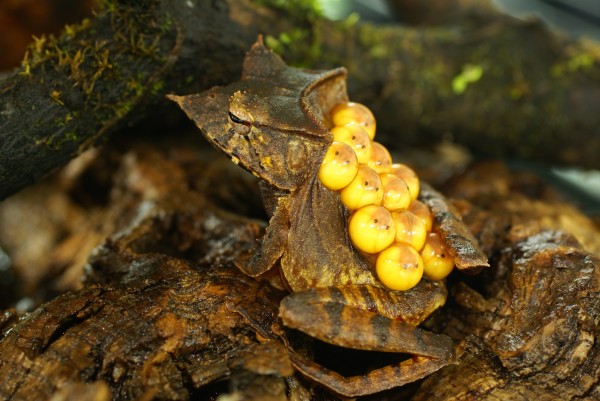
Is that a leaf? Look closely!

January 30th, 2012 No comments
Leaf litter toad (Rhaebo haematiticus)

Leaf litter toad (Rhaebo haematiticus)

Cute Frog of the Week: January 30, 2012

Can you be-leaf that this is a frog? If you don’t look closely, you might just miss the litter frog if you come across it in the forest. Even though it is relatively large in size, with females that can grow up to 3 inches in length, it practically disappears among leaf litter and tree bark. This ‘dead leaf’ pattern on its back is excellent camouflage and is most often brown or purplish in color with darker blackish and lighter yellow-orange blotches. Their toes are also webbed, but their fingers are not.

These frogs range from eastern Honduras and Costa Rica to Columbia and northwestern Ecuador. In general, these frogs are most commonly seen in Costa Rica, though their population fluctuates and their overall numbers seem to be decreasing.

Litter frogs are nocturnal and live in either tropical forests or humid, moist woodland areas along streams or rivers. They breed during the wet seasons from March to July, and prefer to do so in rocky freshwater pools along the edges of streams where their twilight chorus could easily be mistaken for birdsong. Once the breeding season is over, they often move elsewhere to slightly drier areas.

The main threats to this species are habitat degradation and destruction due to agriculture, wood extraction and cattle ranching. The species is locally threatened by dams in Venezuela and by oil pollution in Colombia. Chytrid fungus also seems to be affecting this species.

Photo by Brian Gratwicke, Smithsonian Conservation Biology Institute.

Every week the Panama Amphibian Rescue and Conservation Project posts a new photo of a cute frog from anywhere in the world with an interesting, fun and unique story to tell. Be sure to check back every Monday for the latest addition.

Send us your own cute frogs by uploading your photos here: http://www.flickr.com/groups/cutefrogoftheweek/