New Research Identifies Disease-Free Havens Where Captive-Bred
Frogs May Have the Best Chance of Survival
As a deadly fungal disease ravages wild frog populations around the globe, scientists have identified potential locations in Panama where amphibians might persist despite the presence of disease, according to new research from the Smithsonian’s National Zoo and Conservation Biology Institute (NZCBI) and Smithsonian Tropical Research Institute (STRI) published today in the Journal for Nature Conservation.
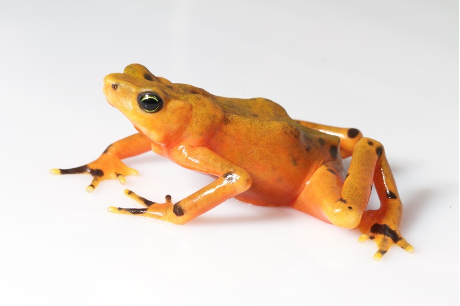
The amphibian chytrid disease, also known as chytridiomycosis or simply chytrid, is caused by the fungus Batrachochytrium dendrobatidis. It has spread like wildfire through Central and South America since the 1970s and is now ubiquitous. It is believed to have driven numerous species of neotropical frogs to the brink of extinction, including many in the genus Atelopus, commonly known as harlequin toads. Now, as conservationists attempt to reintroduce captive-bred species to the wild, they hope to give the animals a leg up by identifying climatic refugia—places that are environmentally unsuitable for chytrid, but perfect for frogs.
The chytrid fungus is present across almost all of the historic range of Atelopus species, but just as human influenza cases change with the seasons, the chytrid disease fluctuates in its severity depending on the temperature and humidity. Using previously developed models that identified locations where the disease was present and the seasons when the disease was most severe, the authors built new chytrid suitability maps where reintroduced frogs might thrive without the threat of chytrid.
“We have tried releasing captive-bred harlequin toads back into the wild and experienced high losses due to the amphibian chytrid fungus that persists in the environment,” said Brian Gratwicke, conservation biologist at NZCBI and senior author of the article. “By mapping climatic refuges, we finally have a tool to rank potential release sites, allowing us to select places where the released animals have the best chance of survival.”
Researchers found most harlequin toad species in Panama only persist at sites where more than 80% of the seasons were unsuitable for medium and high-intensity infections. Only one species, the variable harlequin toad (A. varius), was found in sites suitable for the disease, which scientists say is consistent with evidence that the species may have evolved resistance to chytrid.
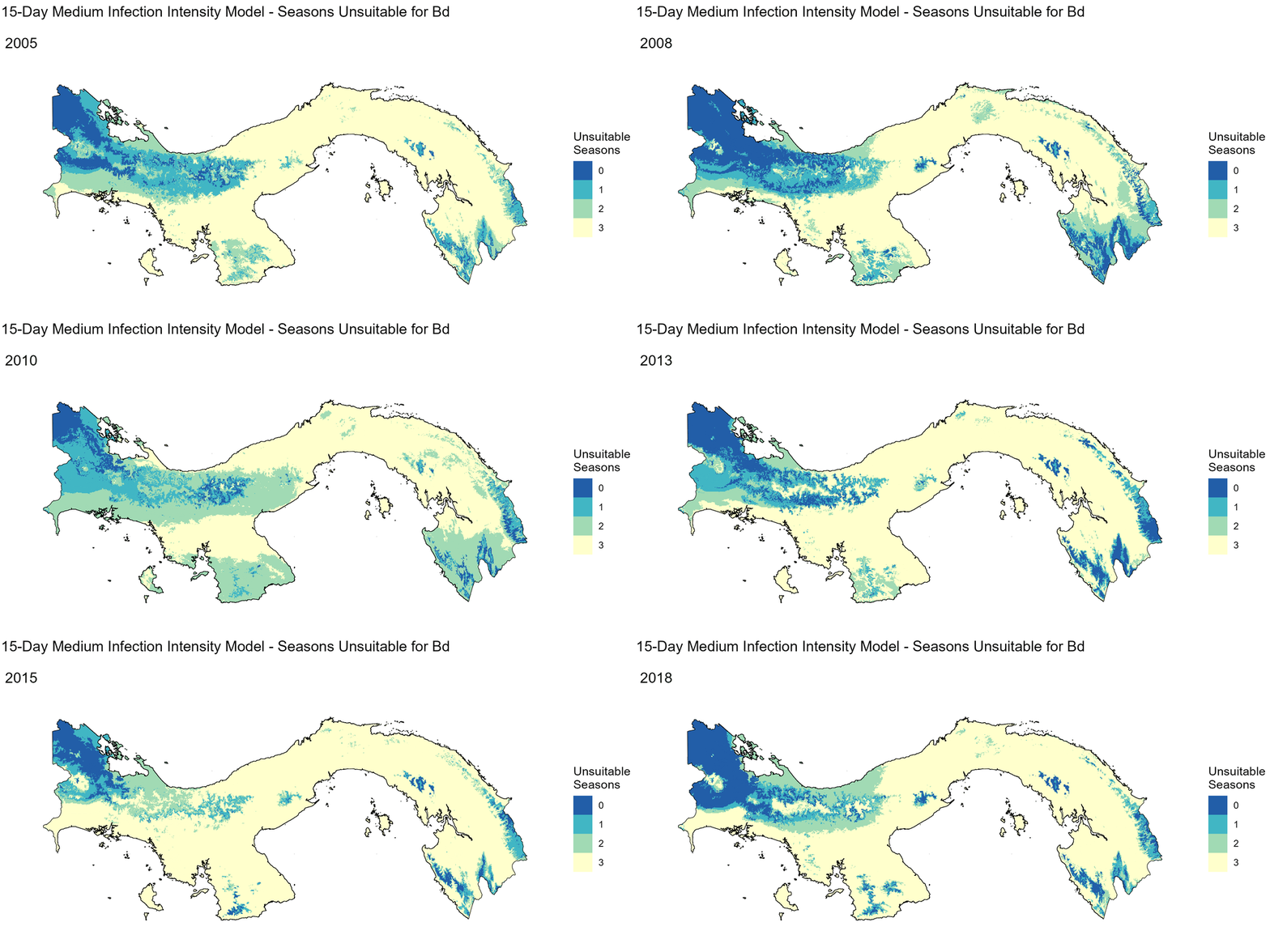
Not only do the models identify potential locations for reintroduction sites, they also provide locations where existing wild Atelopus populations might remain.
“Our ability to identify climate refugia is critical if we hope to locate populations that might have disappeared from most places in their former range,” said Carrie Lewis, doctoral candidate at George Mason University and lead author of the publication. “These persisting populations could provide a source of genes to bolster populations under human care and provide opportunities to augment wild populations.”
Although there are currently a limited number of potential refuges, additional opportunities have been identified. The models also forecasted areas that, while currently suitable for the disease, might become unsuitable in the coming years due to climate change. Researchers note the shifting climate could also have negative effects on frogs that are adapted to cooler mountainous habitats.
“Guided by these climate refugia and Atelopus habitat-suitability maps, we have already begun surveying potential sites for habitat suitability and potential release trials,” said Roberto Ibáñez, STRI staff scientist and co-author of the study. “These tools will allow us to experimentally test the climate refugia hypothesis through future release trials.”
About the Smithsonian’s National Zoo and Conservation Biology Institute
NZCBI leads the Smithsonian’s global effort to save species, better understand ecosystems and train future generations of conservationists. Its two campuses are home to more than 2,200 animals, including some of the world’s most critically endangered species. Always free of charge, the Zoo’s 163-acre park in the heart of Washington, D.C., features animals representing 400 species and is a popular destination for children and families. At the Conservation Biology Institute’s 3,200-acre campus in Virginia, breeding and veterinary research on nearly 250 animals representing 20 species provide critical data for the management of animals in human care and valuable insights for conservation of wild populations. NZCBI’s 305 staff and scientists work in Washington, D.C., Virginia and with partners at field sites across the United States and in more than 45 countries to save wildlife, collaborate with communities and conserve native habitats. NZCBI is a long-standing accredited member of the Association of Zoos and Aquariums.
About the Smithsonian Tropical Research Institute
Headquartered in Panama City, Panama, STRI is a unit of the Smithsonian Institution. Our mission is to understand tropical biodiversity and its importance to human welfare, to train students to conduct research in the tropics and promote conservation by increasing public awareness of the beauty and importance of tropical ecosystems. Visit the institute at our website and on Facebook, X and Instagram for updates.
About the Panama Amphibian Rescue and Conservation Project
Founded in 2009, the Panama Amphibian Rescue and Conservation Project (PARC) is a collaboration between Zoo New England, Cheyenne Mountain Zoo, Smithsonian’s National Zoo and Conservation Biology Institute and the Smithsonian Tropical Research Institute. PARC seeks to build captive populations of species at risk of extinction, develop methodologies to reduce the impact of the amphibian chytrid fungus and reintroduce imperiled species to the wild. This research was supported in part by the Bezos Earth Fund.
# # #


