Hope Returns to Panama’s Forests With the Rediscovery of Four Missing Frog Species 

Smithsonian scientist Brian Gratwicke and colleagues describe how emerging technology aided the remarkable rediscovery of four amphibian populations thought to have vanished from Panama’s mountain forests. 

By Brian Gratwicke 

We’re thrilled to share some encouraging news from the mountains of Panama. After nearly two decades of silence, we’re hearing the calls of frogs that were thought to be lost forever. The rediscovery of four amphibian populations missing since the mid-2000s offers rare and encouraging news for some of the world’s most threatened animals. 

A coronated treefrog (Triprion spinosus) inside a laboratory habitat at Smithsonian Tropical Research Institute in Gamboa in Gamboa, Panama. (Roshan Patel/Smithsonian)

Our team at the Panama Amphibian Rescue and Conservation project includes several researchers with decades of field experience. But even for the most seasoned researchers, documenting missing species remains one of conservation biology’s greatest challenges. How do you prove a species is truly gone and not just extremely difficult to find? 

In recent decades, the fungal disease chytridiomycosis wiped out amphibian populations worldwide, causing declines and extinctions in nearly a hundred species. We focused our search on species that vanished from central Panama during the devastating chytrid outbreaks of 2004-2009 including the potentially extinct Rabb’s fringe-limbed treefrog  (Ecnomiohyla rabborum). The 2024 IUCN Global Amphibian Assessment flagged several species from central Panama as missing, but officially declaring a species extinct requires years of concerted, documented effort.  

With recent advances in acoustic recording and analysis technology, and armed with a recording of the Rabb’s treefrog call from the Atlanta Botanical Garden, we saw an opportunity to revisit the forests with new tools. By focusing on Rabb’s treefrog, we also sought to honor the legacy of George Rabb, an influential amphibian conservationist whose work continues to inspire this research.   

A view of the Altos de Campana National Park in Panama. The Panama Amphibian Rescue and Conservation Project is a partnership between the Smithsonian Institution, the Cheyenne Mountain Zoo and Zoo New England that seeks to rescue and establish assurance colonies of amphibian species that are in extreme danger of extinction throughout Panama. (Roshan Patel/Smithsonian)

In 2022 and again in 2024, our team deployed autonomous recording units – essentially small microphones that automatically capture forest sounds – across three localities in Panama’s central cordillera. During the early rainy season, we recorded the soundscape for one minute of sound every ten minutes, day and night.  We also conducted traditional visual and auditory frog surveys along a 100-meter transect.  

Smithsonian researcher Roberto Ibáñez places an audiomoth used to record 1 minute of sound every 10 minutes for acoustic analysis in Altos de Campana National Park. (Brian Gratwicke / Smithsonian)

The results were astonishing. Using sophisticated pattern-matching software to analyze the recordings, we documented four species on the IUCN Red List of Threatened Species that had seemingly vanished from these forests.  Most remarkably, we detected more than 400 calls from the endangered Vicente’s dart frog (Oophaga vicentei), a metallic green-and-black species that was presumed extinct in this region according to the IUCN. We also found the Boquete rocket frog (Silverstoneia nubicola), which disappeared from Altos de Campana National Park nearly 20 years ago, and the crowned treefrog (Triprion spinosus), a hole-breeding specialist that survives in Mexico and Costa Rica but has not been seen in Panama’s forests for a decade. 

A gallery of frogs rediscovered through acoustic monitoring and physical surveys in central Panama. Images show a Vicente’s poison frog (top left), a Boquete rocket frog (top middle), a  Lemur leaf frog (top right), a Veragua fringe-limbed treefrog (bottom left), and a crowned treefrog (bottom right).

The technology proved to be remarkably effective. Our autonomous recording units detected common frog species at twice as many locations as traditional day-and-night surveys alone.  

In total, the devices captured more than 128,000 one-minute recordings, creating an acoustic archive that reveals patterns about frog behavior that we’ve never documented before. For instance, we discovered that the Boquete rocket frog calls primarily at dawn and dusk, a narrow window that helps explain why earlier surveys may have missed it. 

While we didn’t find evidence of the critically endangered Rabb’s fringe-limbed treefrog, we did make a surprising discovery. Along our transect, we encountered a juvenile frog of the same Ecnomiohyla genus on our transect with a malformed hand. We brought him back to the Amphibian Rescue Center for genetic testing. Results revealed it was not Rabb’s frog, but the Veragua fringe-limbed treefrog (Ecnomiohyla veraguensis). Our staff named him Han Solo.  

Because of his deformity, we did not release the frog back into the wild – but he offered an unexpected gift. We recorded his adorable Chihuahua-like bark on video and used it as a template for pattern-matching. That recording led us to detect other Veragua fringe-limbed treefrogs at that same site, validating our approach for locating elusive, canopy-dwelling species. 

Across our survey sites, the entire amphibian community is showing signs of partial recovery. Frog abundance now averages about six individuals per 100-meter transect—still below pre-decline levels, but a significant improvement from the devastation of 2006.  

The fungal pathogen Batrachochytrium dendrobatidis persists in the environment, infecting about 21% of amphibians we tested. Even so, several species appear to be rebounding, suggesting some may be developing disease resistance. For amphibian populations once considered doomed, this discovery offers genuine hope for the future. 

Not all species have returned. Pratt’s rocket frog (Colostethus pratti), once the most abundant rocket frog at Cerro Campana, was absent from that locality despite recovering elsewhere. This absence presents an opportunity for conservation action – we are now conducting experimental translocations of potentially disease-resistant individuals to test whether we can take human-assisted actions to help restore lost species and revitalize the forest’s natural soundscape. 

—- 

The Panama Amphibian Rescue and Conservation Project is a partnership between the Smithsonian’s National Zoo and Conservation Biology Institute, the Smithsonian Tropical Research Institute, Cheyenne Mountain Zoo and Zoo New England.  This project was sponsored by the Shared Earth Foundation in honor of prominent amphibian advocate and conservationist George Rabb. Our staff are supported by the Bezos Earth Fund, an anonymous foundation and other sustaining donors 

 Our findings were recently published in Frontiers in Amphibian and Reptile Science: 

 Gratwicke, B.,  Guerrel, J., Garces, O.,  Illueca, E.,  Weisenbeck, N.J.,  Deichmann, J.L., Ibáñez, R.  Rediscovery of frogs of conservation concern in Panama using passive acoustic monitoring and pattern-matching analysis   Front. Amphib. Reptile Sci. 3:1736880. doi: 10.3389/famrs.2025.1736880   

Giving Tadpoles a Fighting Chance: A Novel Approach to Saving the Lemur Leaf Frog

When conservationists prepare to release endangered species back into the wild, they face a critical question: how do we give them the best chance at survival? For the lemur leaf frog (Agalychnis lemur), a species that has vanished from most known sites across its range, researchers are literally thinking outside the box.

Rather than releasing adult frogs directly into Panama’s forests, our research team took an innovative approach: introducing tadpoles bred in human care into large soft-release containers in the wild. Half of the containers were treated with antifungals to see if protecting animals at this critical stage can help frog survival.  This early intervention targets one of amphibians’ most devastating threats—the chytrid fungus Batrachochytrium dendrobatidis (Bd)—at a vulnerable life stage, potentially offering protection as the tadpoles metamorphose into adult frogs.

Agalychnis lemur breeds in slow-flowing swampy conditions. The species has experienced dramatic chytridiomycosis-related declines and has disappeared from most known sites, including a formerly occupied location in Altos de Campana National Park. While the species is breeding well in captivity and showing signs of recovery at a few sites in Costa Rica and Panama, these release trials could inform recovery efforts at many sites where this species has disappeared.

Previous research has shown promising results with fungicide treatments in artificial pond environments. Studies found that commonly used agricultural fungicides can reduce or eliminate Bd infections in susceptible tadpoles, with the fungicide degrading quickly and causing no significant harm to pond ecosystems or invertebrate communities.

This lemur leaf frog project brings together expertise from multiple institutions, including Gonçalo Rosa from IMIB Biodiversity Research Institute (CSIC) and ZSL, along with partners from the Panama Amphibian Rescue and Conservation Project, the Cheyenne Mountain Zoo, and Zoo New England. By creating artificial breeding points that can be safely treated with antifungal agents to reduce pathogen loads, the team is developing a replicable model that could help other endangered amphibian species facing similar threats.

The experiment is now underway, and researchers are monitoring whether this early antifungal protection helps the tadpoles survive disease once they complete metamorphosis. The results could inform future amphibian reintroduction programs worldwide, offering a practical tool in the fight against one of the most destructive wildlife diseases on the planet.


This research represents a collaborative effort to develop evidence-based conservation strategies for critically endangered amphibians in the face of emerging infectious diseases called the Tropical Amphibian Resilience Initiative funded by the Bezos Earth Fund and other donors to the Panama Amphibian Rescue and Conservation Project.  

Scientists Use Climate Data to Map, Predict Amphibian Chytrid Disease

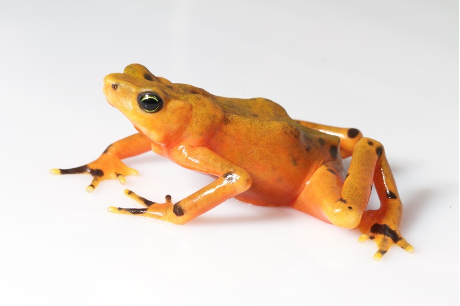
Photo of a dead frog infected with the chytrid fungus. The frog is emaciated and its belly and legs are covered in red lesions.

The chytrid fungus disease is responsible for global amphibian population declines, such as the endangered limosa harlequin frog shown above. (Brian Gratwicke/Smithsonian’s National Zoo and Conservation Biology Institute)

Researchers may have a new tool in the fight to protect neotropical frogs from extinction, thanks to climate data. In a recently published study in the journal Diversity and Distributions, researchers from the Smithsonian’s National Zoo and Conservation Biology Institute (NZCBI) and the Smithsonian Tropical Research Institute (STRI) created a high-resolution map of Panama showing how a deadly amphibian disease moved across Panama over a 13-year period. But the data also provides insight into where the disease is the most dangerous and shows regions that may be havens for reintroduced, captive-bred frogs.  

Since its first scientific description in 2000, Batrachochytrium dendrobatidis (Bd), a fungus that causes the deadly amphibian chytrid disease, has devastated amphibian populations in Central and South America. Believed to have originated in Asia, chytrid has since spread to many parts of the world, and the disease is responsible for wiping out nine frog species in Panama alone.   

Like other fungi, chytrid requires a cool, wet environment to thrive. In chytrid-friendly conditions, disease outbreaks can decimate frog populations. But scientists have found that the fungus cannot thrive when the temperature is too high or the air is too dry. While the disease has spread throughout mainland Panama, the team wondered if the climate parameters might create an opportunity to find pockets where chytrid was less likely to kill.  

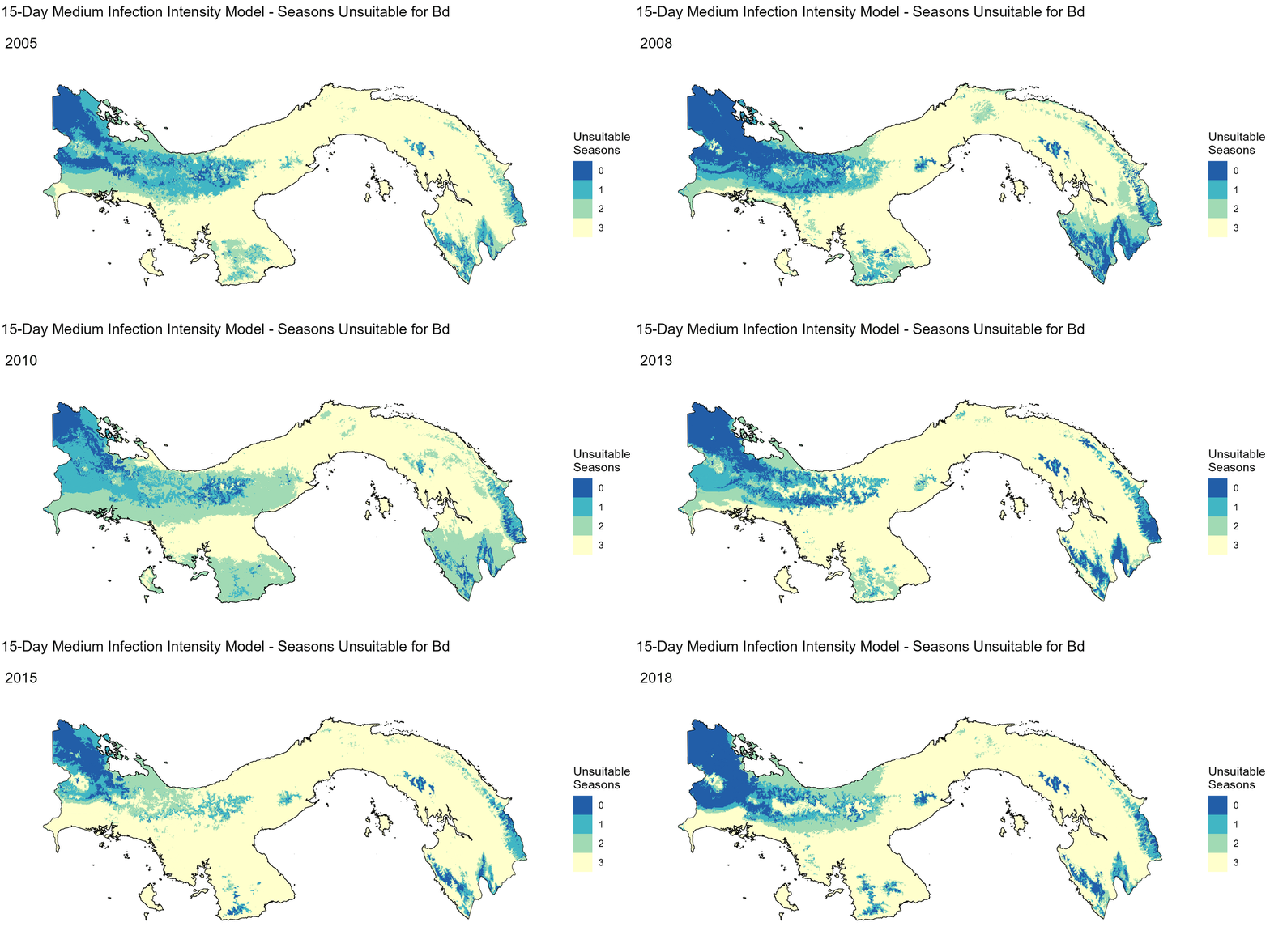
By pairing satellite data with 13 years’ worth of atmospheric modeling, researchers created an ultra-high-resolution, daily temperature and humidity map for the nation. They paired this with a second dataset of over 4,900 disease samples taken from 314 sites across Panama. The second dataset tracked the amount of fungus present on each frog, known as the fungal load, over 13 years. When overlaid, the two data sets provided a clear picture of when and where the chytrid disease was the most intense. Higher elevations consistently remained more hospitable to the fungus, but rainy seasons brought chytrid-friendly conditions to the lowlands and led to waves of outbreaks.  

igh resolution chytrid model predicting the distribution of medium intensity chytrid infections in Panama

“By compiling the hard-earned data from many amphibian researchers, we have been able to draw an unprecedented, detailed picture of the intensity of Bd in Panama through time and space,” said Carrie Lewis, doctoral student at George Mason University’s Department of Geography and Geoinformation Science, who led the study. “My hope is that we can use this detailed information to inform conservation actions in a more refined way.”  

Although chytrid disease has devastated amphibian populations, the presence of the chytrid fungus alone is not a death sentence. Recognizing this, the research team built three models: one showing fungal presence; a second at “medium intensity,” which researchers consider an indicator of a serious infection; and a third at “high intensity,” which researchers associated with significant disease outbreaks. Researchers found that by examining the weather conditions 15 days prior to sampling, they could predict the presence and intensity of the chytrid fungus.   

By mapping out the path and intensity of chytrid, it became clear that the disease thrives in mountainous regions, which tend to remain cooler and more humid than lowland areas. With this knowledge, researchers may be able to identify climatic refuges—areas less suitable for the chytrid disease where frogs may have a fighting chance against the fungus.  

“The ability to identify places where frogs might be able to survive chytrid is critical for two reasons,” said Brian Gratwicke, NZCBI biologist and senior author of the study. “One, it allows us to look for frogs in those areas who might have developed resistance to the fungus. Two, those same areas might be sites where we can return captive-bred frogs into the wild. Both aspects could be significant turning points in the fight against the chytrid disease.”  

Since 2009, the Panama Amphibian Rescue and Conservation Project based in Gamboa, Panama, has bred 12 species of frogs, all of which are facing extinction. After years of successful breeding, there are now enough animals to begin rewilding efforts. As researchers work toward reintroduction trials for imperiled Panamanian species, these prediction models will be crucial to determining when and where trials should take place.  

This collaboration between 18 coauthors was partially supported with funding from the National Science Foundation, the German Science Foundation and the Bezos Earth Fund through the Tropical Amphibian Research Initiative.