Tadpoles can carry low-level infections of the amphibian chytrid fungus without appearing sick, making these infections easy to overlook. A new study published in Herpetologica shows that more thorough testing can substantially improve their detection and provide a clearer understanding of how the pathogen persists in amphibian communities.
The research was conducted by Kelsey Wilson as part of her master’s thesis at McGill University under the supervision of Virginie Millien and Roberto Ibáñez. Wilson led the collection and analysis of 409 tadpoles representing seven species from five streams in Soberanía National Park, Panama. At the Smithsonian Tropical Research Institute, laboratory technician Estefany Illueca performed the quantitative PCR (qPCR) tests used to detect the chytrid fungus.
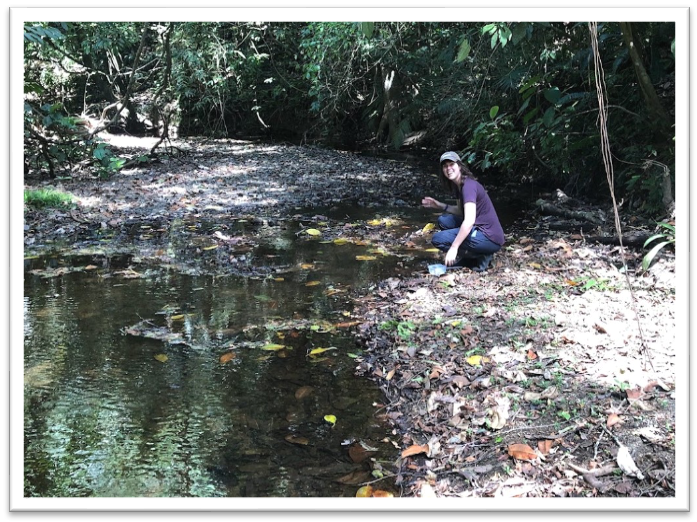
Kelsey Wilson collecting tadpoles from a stream in Soberanía National Park.
The study focused on Batrachochytrium dendrobatidis (Bd), the fungus that causes chytridiomycosis and has contributed to severe amphibian declines worldwide. Each tadpole sample was tested in three separate qPCR reactions, or wells. Most infected tadpoles carried very small amounts of the fungus, which were often detected in only one of the three wells. If the researchers had required at least two positive wells to classify a tadpole as infected, nearly two-thirds of the positive samples in the initial analysis would have been overlooked.
The researchers therefore recommend testing each sample in at least three replicate wells and considering a tadpole infected when Bd is detected in at least one of them.
Using this approach, Bd was detected in 48 of the 409 tadpoles. Infections occurred in three common stream species: the Panama cross-banded treefrog (Smilisca sila), forest toad (Rhinella alata), and rainforest rocket frog (Silverstoneia flotator). Because these tadpoles were relatively abundant and generally carried low-intensity infections, their populations could potentially help maintain the fungus in streams and act as reservoir hosts.
Estefany Illueca pipetting DNA extracts for qPCR analysis.
“Detecting these low-level infections is important because tadpoles may survive while carrying the fungus and contribute to its persistence in the environment,” said Roberto Ibáñez, director of the Panama Amphibian Rescue and Conservation Project and a coauthor of the study. “More reliable diagnosis gives us a clearer picture of disease dynamics and helps us make better-informed conservation decisions.”
Wilson emphasized the broader significance of the findings: “I hope that our study can make a meaningful contribution to the field and help shed light on the importance of considering all developmental stages when studying diseases like chytrid, which affect species with complex life cycles spanning both aquatic and terrestrial habitats.”
Smithsonian scientist Brian Gratwicke and colleagues describe how emerging technology aided the remarkable rediscovery of four amphibian populations thought to have vanished from Panama’s mountain forests.
By Brian Gratwicke
We’re thrilled to share some encouraging news from the mountains of Panama. After nearly two decades of silence, we’re hearing the calls of frogs that were thought to be lost forever. The rediscovery of four amphibian populations missing since the mid-2000s offers rare and encouraging news for some of the world’s most threatened animals.
A coronated treefrog (Triprion spinosus) inside a laboratory habitat at Smithsonian Tropical Research Institute in Gamboa in Gamboa, Panama. (Roshan Patel/Smithsonian)
Our team at the Panama Amphibian Rescue and Conservation project includes several researchers with decades of field experience. But even for the most seasoned researchers, documenting missing species remains one of conservation biology’s greatest challenges. How do you prove a species is truly gone and not just extremely difficult to find?
In recent decades, the fungal disease chytridiomycosis wiped out amphibian populations worldwide, causing declines and extinctions in nearly a hundred species. We focused our search on species that vanished from central Panama during the devastating chytrid outbreaks of 2004-2009 including the potentially extinct Rabb’s fringe-limbed treefrog (Ecnomiohyla rabborum). The 2024 IUCN Global Amphibian Assessment flagged several species from central Panama as missing, but officially declaring a species extinct requires years of concerted, documented effort.
With recent advances in acoustic recording and analysis technology, and armed with a recording of the Rabb’s treefrog call from the Atlanta Botanical Garden, we saw an opportunity to revisit the forests with new tools. By focusing on Rabb’s treefrog, we also sought to honor the legacy of George Rabb, an influential amphibian conservationist whose work continues to inspire this research.
A view of the Altos de Campana National Park in Panama. The Panama Amphibian Rescue and Conservation Project is a partnership between the Smithsonian Institution, the Cheyenne Mountain Zoo and Zoo New England that seeks to rescue and establish assurance colonies of amphibian species that are in extreme danger of extinction throughout Panama. (Roshan Patel/Smithsonian)
In 2022 and again in 2024, our team deployed autonomous recording units – essentially small microphones that automatically capture forest sounds – across three localities in Panama’s central cordillera. During the early rainy season, we recorded the soundscape for one minute of sound every ten minutes, day and night. We also conducted traditional visual and auditory frog surveys along a 100-meter transect.
Smithsonian researcher Roberto Ibáñez places an audiomoth used to record 1 minute of sound every 10 minutes for acoustic analysis in Altos de Campana National Park. (Brian Gratwicke / Smithsonian)
The results were astonishing. Using sophisticated pattern-matching software to analyze the recordings, we documented four species on the IUCN Red List of Threatened Species that had seemingly vanished from these forests. Most remarkably, we detected more than 400 calls from the endangered Vicente’s dart frog (Oophaga vicentei), a metallic green-and-black species that was presumed extinct in this region according to the IUCN. We also found the Boquete rocket frog (Silverstoneia nubicola), which disappeared from Altos de Campana National Park nearly 20 years ago, and the crowned treefrog (Triprion spinosus), a hole-breeding specialist that survives in Mexico and Costa Rica but has not been seen in Panama’s forests for a decade.
A gallery of frogs rediscovered through acoustic monitoring and physical surveys in central Panama. Images show a Vicente’s poison frog (top left), a Boquete rocket frog (top middle), a Lemur leaf frog (top right), a Veragua fringe-limbed treefrog (bottom left), and a crowned treefrog (bottom right).
The technology proved to be remarkably effective. Our autonomous recording units detected common frog species at twice as many locations as traditional day-and-night surveys alone.
In total, the devices captured more than 128,000 one-minute recordings, creating an acoustic archive that reveals patterns about frog behavior that we’ve never documented before. For instance, we discovered that the Boquete rocket frog calls primarily at dawn and dusk, a narrow window that helps explain why earlier surveys may have missed it.
While we didn’t find evidence of the critically endangered Rabb’s fringe-limbed treefrog, we did make a surprising discovery. Along our transect, we encountered a juvenilefrog of the same Ecnomiohyla genus on our transect with a malformed hand. We brought him back to the Amphibian Rescue Center for genetic testing. Results revealed it was not Rabb’s frog, but the Veragua fringe-limbed treefrog (Ecnomiohyla veraguensis). Our staff named him Han Solo.
Because of his deformity, we did not release the frog back into the wild – but he offered an unexpected gift. We recorded his adorable Chihuahua-like bark on video and used it as a template for pattern-matching. That recording led us to detect other Veragua fringe-limbed treefrogs at that same site, validating our approach for locating elusive, canopy-dwelling species.
Across our survey sites, the entire amphibian community is showing signs of partial recovery. Frog abundance now averages about six individuals per 100-meter transect—still below pre-decline levels, but a significant improvement from the devastation of 2006.
The fungal pathogen Batrachochytrium dendrobatidis persists in the environment, infecting about 21% of amphibians we tested. Even so, several species appear to be rebounding, suggesting some may be developing disease resistance. For amphibian populations once considered doomed, this discovery offers genuine hope for the future.
Not all species have returned. Pratt’s rocket frog (Colostethus pratti), once the most abundant rocket frog at Cerro Campana, was absent from that locality despite recovering elsewhere. This absence presents an opportunity for conservation action – we are now conducting experimental translocations of potentially disease-resistant individuals to test whether we can take human-assisted actions to help restore lost species and revitalize the forest’s natural soundscape.
—-
The Panama Amphibian Rescue and Conservation Project is a partnership between the Smithsonian’s National Zoo and Conservation Biology Institute, the Smithsonian Tropical Research Institute, Cheyenne Mountain Zoo and Zoo New England. This project was sponsored by the Shared Earth Foundation in honor of prominent amphibian advocate and conservationist George Rabb. Our staff are supported by the Bezos Earth Fund, an anonymous foundation and other sustaining donors
Our findings were recently published in Frontiers in Amphibian and Reptile Science:
What makes a good home for a crowned tree frog Triprion spinosus? That’s the question Smithsonian scientists set out to answer as they work to reintroduce captive-bred frogs back into their natural habitat.
In the wild, male crowned tree frogs are picky about real estate. They search for water-filled tree cavities where they call out to potential mates. If a female approves of his choice, she’ll lay her eggs in that carefully selected pool.
But when releasing frogs bred under human care, researchers wanted to stack the odds in their favor. The solution? Build artificial tree holes from different materials and let the frogs choose their favorites.
Newly released frogs began exploring right away, and we were able to track their movements for the first few weeks using a radiotransmitter. Before long, their calls echoed through the forest as they settled into their new homes, we will continue monitoring the artificial tree holes to see if we get any eggs laid in these structures and continue to explore other tree hole designs.
This research is part of the Tropical Amphibian Research Initiative, supported by the Bezos Earth Fund and conducted through collaboration among the Panama Amphibian Rescue and Conservation Project.
From the humid lowlands of Mexico to the tropical forests of Colombia, one sound unites the nocturnal chorus of Latin America: the distinctive tungara frog call. These small amphibians, scientifically known as Engystomops pustulosus, create one of nature’s most recognizable and beloved soundscapes across Central and South America.
The Magic of Tungara Frog Sounds
The tungara frog call is unmistakable—a sharp “tunk” followed by a descending whine that sounds almost electronic. Males gather near temporary pools, ponds, and puddles after rainfall, creating symphonies that can be heard for miles. Their vocalizations serve a crucial purpose: attracting females during breeding season, which typically coincides with the rainy months.
Cultural Connection Across Generations
For millions of people across Latin America, tungara frog sounds represent more than just amphibian biology—they’re the soundtrack to childhood memories, rainy evenings, and the rhythm of tropical life. Grandparents in rural villages often tell stories timed to the evening chorus, while children learn to identify the approach of rain by the intensity of the frogs’ calls.
Natural History and Habitat
Tungara frogs are remarkably adaptable, thriving in both pristine rainforests and human-modified landscapes. They prefer shallow, temporary water sources for breeding, making them common around homes, farms, and urban areas. This adaptability has helped preserve their populations even as development spreads across their range.
These resilient amphibians typically measure just 2-3 centimeters long, with bumpy, warty skin that helps them blend into leaf litter during daylight hours. Their calls intensify during peak rainy season, creating the iconic soundscape that has become synonymous with tropical nights from Mexico’s Yucatan Peninsula to Colombia’s Pacific coast.
The tungara frog’s voice continues to connect communities across Latin America, proving that sometimes the smallest creatures create the most enduring memories.