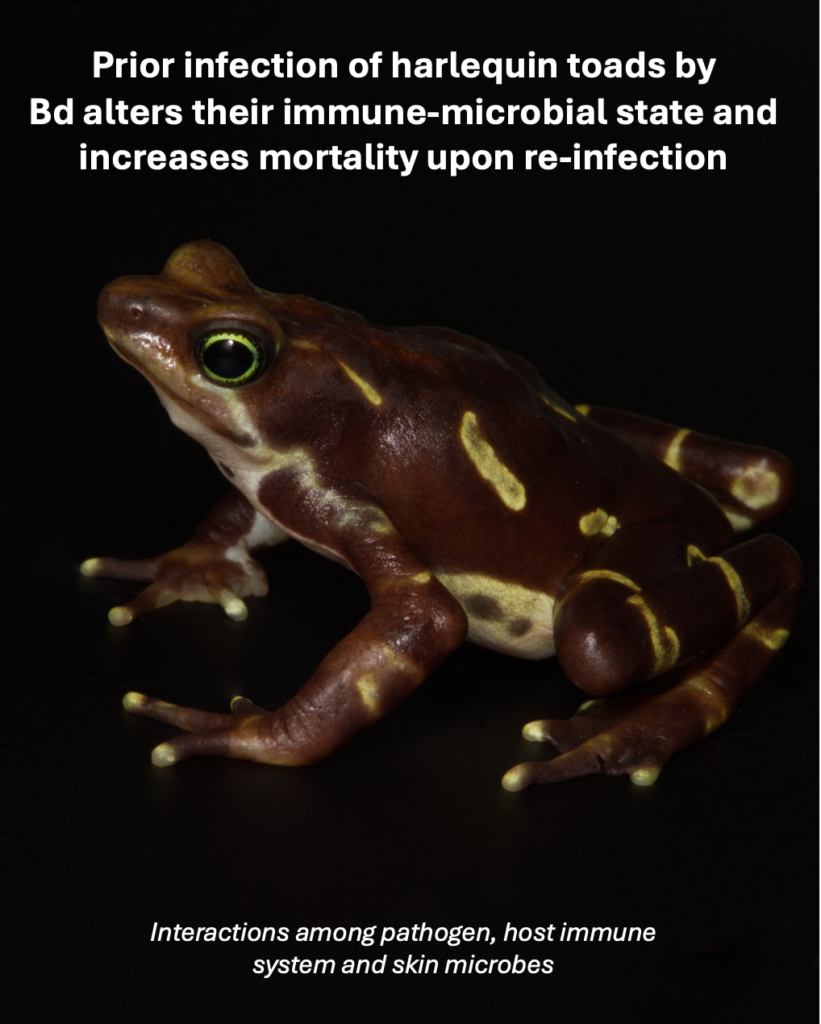
The amphibian chytrid fungus (Batrachochytrium dendrobatidis, or “Bd”) has been linked to the decline or disappearance of roughly 200 amphibian species, and nowhere has the damage been worse than among harlequin toads of the genus Atelopus. Today, 93% of harlequin toad species are threatened with extinction, largely because of this pathogen. One strategy that has helped some amphibians survive Bd is borrowed from vaccine science: expose an animal to the fungus, clear the infection with an antifungal drug, and see whether that prior exposure primes the immune response to prepare the animal for its next encounter. We tested this approach in the Pirre harlequin toad (Atelopus glyphus), one of the most imperiled species in our care. The results, published this month in BMC Genomics found that prior infection did not protect frogs from subsequent infections.
The experiment
We infected captive-bred A. glyphus with live Bd, cleared the infection with a 10-day itraconazole treatment, then waited 90 days before re-exposing them to Bd. We compared these “prior-infected” toads to naïve toads meeting Bd for the first time, tracking disease severity, immune gene expression (via non-lethal toe-clip sampling), and skin microbiome changes throughout. All Bd-exposed toads died, but previously infected toads died faster and developed heavier infections more quickly than toads facing Bd for the first time. Prior infection was a significant, independent predictor of earlier death — the opposite of what a “vaccination” strategy is supposed to achieve.
The immune system never fully recovered, and a shifting microbiome did not protect them
Ninety days after clearance, with no fungus detectable, previously infected toads still showed substantially reduced expression of core adaptive immune genes — the machinery behind immune signaling and lymphocyte responses. Their immune systems hadn’t returned to baseline; they were left in a depressed state. Upon re-infection, these toads didn’t mount a faster, targeted defense. Instead, they showed the same patterns as naïve toads, just more extreme, layered with markers of active immune suppression. Their immune systems appear to remember the infection and mounted a more vigorous immune response, but it was ineffective. The Bd itself may have also had a role in further suppressing some immune responses. Skin bacteria known to fight Bd increased on the skin following the first infection, likely driven by host immune responses. But that shift reversed during re-infection, dropping as disease worsened, and did not provide any protection during reinfection.
These findings indicate that prior exposure as a strategy may not work in some highly susceptible species. This study gives us unique insight into the skin-microbial interface in a highly susceptible species, however, a better understanding of why some individuals seem to have evolved more innate resilience to the pathogen remains a high research priority for harlequin toads as it may allow us to breed more resilient frogs.
Read the full open-access paper in BMC Genomics. Gratwicke B, Osborne OG, Hartmann A, Ávila N, Baitchman E, Togna GD, Figueroa Y, Guerrel J, Illueca E, Linhoff L, Madison JD, Ellison A, Grayfer L, Ibáñez, R, Muletz-Wolz C.R. Prior infection of harlequin toads by Batrachochytrium dendrobatidis alters their immune-microbial state and increases mortality upon re-infection. BMC Genomics. 2026 Sep 2.
New Research Identifies Disease-Free Havens Where Captive-Bred Frogs May Have the Best Chance of Survival
A captive-bred variable harlequin toad (Atelopus varius) at the Panama Amphibian Rescue and Conservation Project.Photo credit: Brian Gratwicke, Smithsonian’s National Zoo and Conservation Biology Institute.
As a deadly fungal disease ravages wild frog populations around the globe, scientists have identified potential locations in Panama where amphibians might persist despite the presence of disease, according to new research from the Smithsonian’s National Zoo and Conservation Biology Institute (NZCBI) and Smithsonian Tropical Research Institute (STRI) published today in the Journal for Nature Conservation.
The amphibian chytrid disease, also known as chytridiomycosis or simply chytrid, is caused by the fungus Batrachochytrium dendrobatidis. It has spread like wildfire through Central and South America since the 1970s and is now ubiquitous. It is believed to have driven numerous species of neotropical frogs to the brink of extinction, including many in the genus Atelopus, commonly known as harlequin toads. Now, as conservationists attempt to reintroduce captive-bred species to the wild, they hope to give the animals a leg up by identifying climatic refugia—places that are environmentally unsuitable for chytrid, but perfect for frogs.
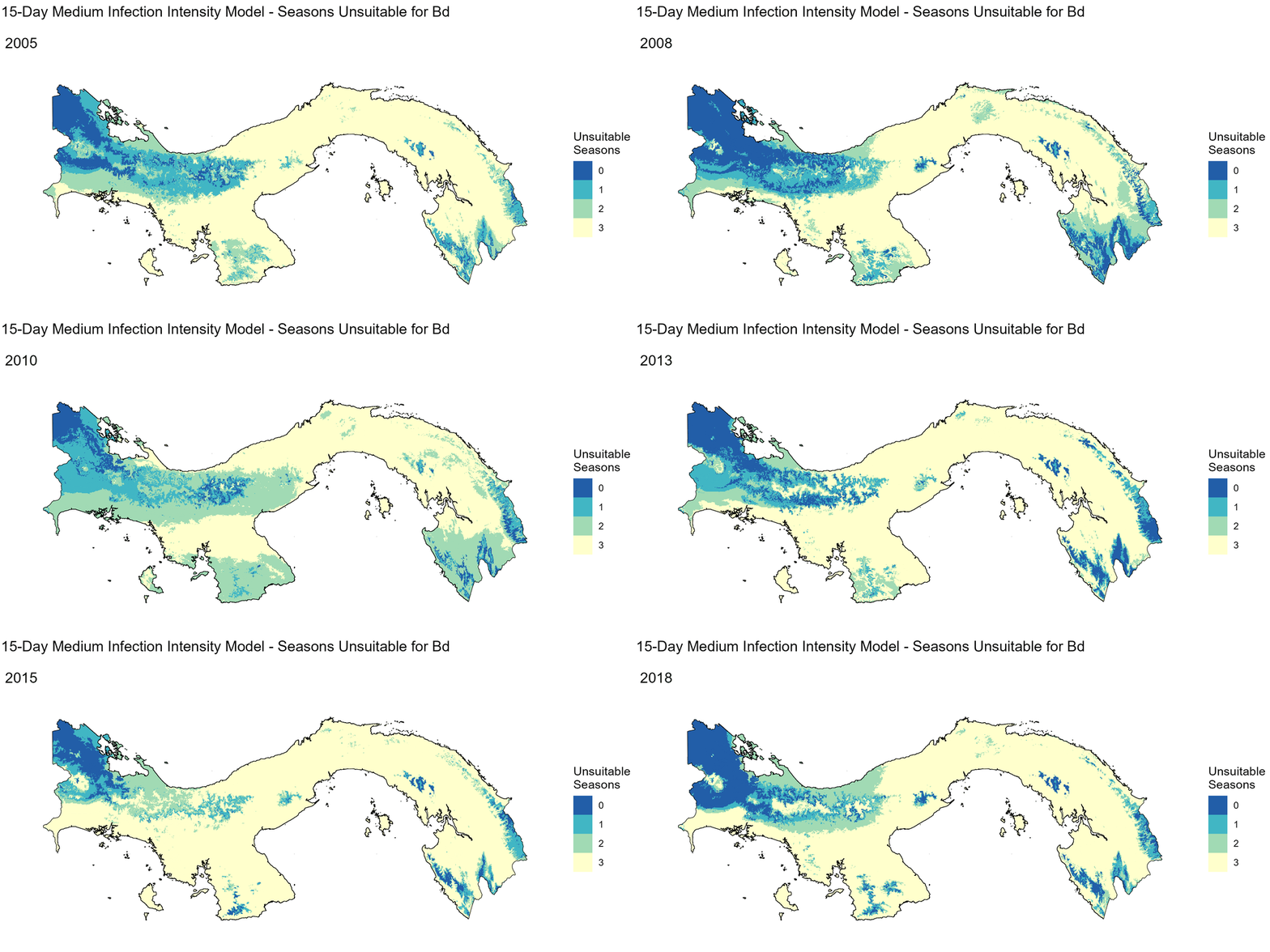
The chytrid fungus is present across almost all of the historic range of Atelopus species, but just as human influenza cases change with the seasons, the chytrid disease fluctuates in its severity depending on the temperature and humidity. Using previously developed models that identified locations where the disease was present and the seasons when the disease was most severe, the authors built new chytrid suitability maps where reintroduced frogs might thrive without the threat of chytrid.
“We have tried releasing captive-bred harlequin toads back into the wild and experienced high losses due to the amphibian chytrid fungus that persists in the environment,” said Brian Gratwicke, conservation biologist at NZCBI and senior author of the article. “By mapping climatic refuges, we finally have a tool to rank potential release sites, allowing us to select places where the released animals have the best chance of survival.”
Researchers found most harlequin toad species in Panama only persist at sites where more than 80% of the seasons were unsuitable for medium and high-intensity infections. Only one species, the variable harlequin toad (A. varius), was found in sites suitable for the disease, which scientists say is consistent with evidence that the species may have evolved resistance to chytrid.
Animated GIF mapping annual variations in chytrid suitability over the 13 year study period.
Not only do the models identify potential locations for reintroduction sites, they also provide locations where existing wild Atelopus populations might remain.
“Our ability to identify climate refugia is critical if we hope to locate populations that might have disappeared from most places in their former range,” said Carrie Lewis, doctoral candidate at George Mason University and lead author of the publication. “These persisting populations could provide a source of genes to bolster populations under human care and provide opportunities to augment wild populations.”
Although there are currently a limited number of potential refuges, additional opportunities have been identified. The models also forecasted areas that, while currently suitable for the disease, might become unsuitable in the coming years due to climate change. Researchers note the shifting climate could also have negative effects on frogs that are adapted to cooler mountainous habitats.
“Guided by these climate refugia and Atelopus habitat-suitability maps, we have already begun surveying potential sites for habitat suitability and potential release trials,” said Roberto Ibáñez, STRI staff scientist and co-author of the study. “These tools will allow us to experimentally test the climate refugia hypothesis through future release trials.”
About the Smithsonian’s National Zoo and Conservation Biology Institute
NZCBI leads the Smithsonian’s global effort to save species, better understand ecosystems and train future generations of conservationists. Its two campuses are home to more than 2,200 animals, including some of the world’s most critically endangered species. Always free of charge, the Zoo’s 163-acre park in the heart of Washington, D.C., features animals representing 400 species and is a popular destination for children and families. At the Conservation Biology Institute’s 3,200-acre campus in Virginia, breeding and veterinary research on nearly 250 animals representing 20 species provide critical data for the management of animals in human care and valuable insights for conservation of wild populations. NZCBI’s 305 staff and scientists work in Washington, D.C., Virginia and with partners at field sites across the United States and in more than 45 countries to save wildlife, collaborate with communities and conserve native habitats. NZCBI is a long-standing accredited member of the Association of Zoos and Aquariums.
About the Smithsonian Tropical Research Institute
Headquartered in Panama City, Panama, STRI is a unit of the Smithsonian Institution. Our mission is to understand tropical biodiversity and its importance to human welfare, to train students to conduct research in the tropics and promote conservation by increasing public awareness of the beauty and importance of tropical ecosystems. Visit the institute at our website and on Facebook, X and Instagram for updates.
About the Panama Amphibian Rescue and Conservation Project
Founded in 2009, the Panama Amphibian Rescue and Conservation Project (PARC) is a collaboration between Zoo New England, Cheyenne Mountain Zoo, Smithsonian’s National Zoo and Conservation Biology Institute and the Smithsonian Tropical Research Institute. PARC seeks to build captive populations of species at risk of extinction, develop methodologies to reduce the impact of the amphibian chytrid fungus and reintroduce imperiled species to the wild. This research was supported in part by the Bezos Earth Fund.
Tadpoles can carry low-level infections of the amphibian chytrid fungus without appearing sick, making these infections easy to overlook. A new study published in Herpetologica shows that more thorough testing can substantially improve their detection and provide a clearer understanding of how the pathogen persists in amphibian communities.
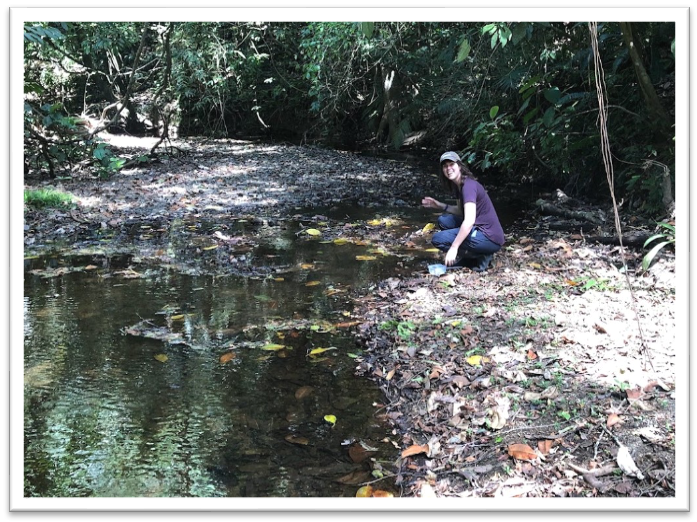
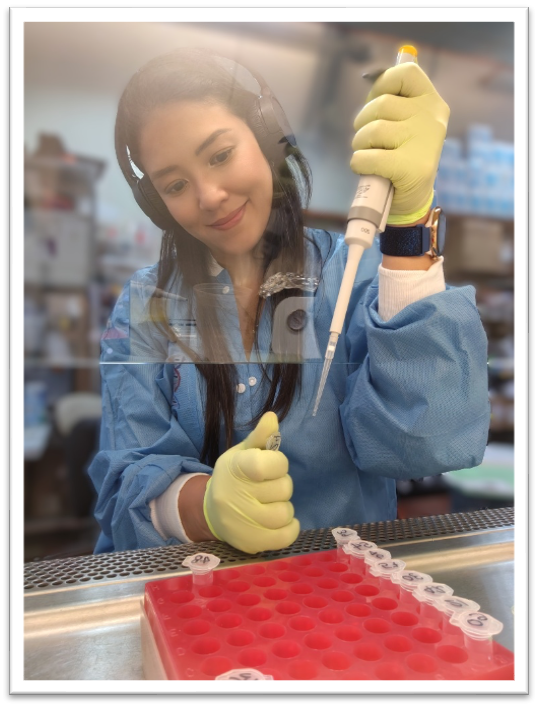
The research was conducted by Kelsey Wilson as part of her master’s thesis at McGill University under the supervision of Virginie Millien and Roberto Ibáñez. Wilson led the collection and analysis of 409 tadpoles representing seven species from five streams in Soberanía National Park, Panama. At the Smithsonian Tropical Research Institute, laboratory technician Estefany Illueca performed the quantitative PCR (qPCR) tests used to detect the chytrid fungus.
Kelsey Wilson collecting tadpoles from a stream in Soberanía National Park.
The study focused on Batrachochytrium dendrobatidis (Bd), the fungus that causes chytridiomycosis and has contributed to severe amphibian declines worldwide. Each tadpole sample was tested in three separate qPCR reactions, or wells. Most infected tadpoles carried very small amounts of the fungus, which were often detected in only one of the three wells. If the researchers had required at least two positive wells to classify a tadpole as infected, nearly two-thirds of the positive samples in the initial analysis would have been overlooked.
The researchers therefore recommend testing each sample in at least three replicate wells and considering a tadpole infected when Bd is detected in at least one of them.
Using this approach, Bd was detected in 48 of the 409 tadpoles. Infections occurred in three common stream species: the Panama cross-banded treefrog (Smilisca sila), forest toad (Rhinella alata), and rainforest rocket frog (Silverstoneia flotator). Because these tadpoles were relatively abundant and generally carried low-intensity infections, their populations could potentially help maintain the fungus in streams and act as reservoir hosts.
Estefany Illueca pipetting DNA extracts for qPCR analysis.
“Detecting these low-level infections is important because tadpoles may survive while carrying the fungus and contribute to its persistence in the environment,” said Roberto Ibáñez, director of the Panama Amphibian Rescue and Conservation Project and a coauthor of the study. “More reliable diagnosis gives us a clearer picture of disease dynamics and helps us make better-informed conservation decisions.”
Wilson emphasized the broader significance of the findings: “I hope that our study can make a meaningful contribution to the field and help shed light on the importance of considering all developmental stages when studying diseases like chytrid, which affect species with complex life cycles spanning both aquatic and terrestrial habitats.”
Panama Amphibian Rescue and Conservation Project Releases Panama’s Critically Endangered Golden Frogs Into the Wild
Team releasing golden frogs from the Panama Amphibian Rescue and Conservation Project (PARC) into their natural habitat. From left to right: Roberto Ibáñez, PARC director; Carlos Moreno, from Panama’s National System of Protected Areas (SiNAP); Oliver Granucci, PARC researcher; Jorge Guerrel, PARC programs manager; Orlando Garcés, PARC research technician, and Joel Reyes, SiNAP staff member. Credit: Ana Endara
Since 2009, no one has seen a Panamanian golden frog in the wild. These bright yellow frogs disappeared completely when an amphibian fungal disease, chytridiomycosis, swept through Panama reaching El Valle de Anton, the last stronghold of golden frogs, in 2004. Researchers at the Smithsonian Institution predicted these declines based on the pattern of disease spread. The Smithsonian Tropical Research Institute (STRI) and Smithsonian’s National Zoo and Conservation Biology Institute (NZCBI) joined with the Cheyenne Mountain Zoo and Zoo New England to build the Panama Amphibian Rescue and Conservation Project (PARC) to safeguard the amphibians most at risk of extinction. After successfully breeding golden frogs and several other species under human care, the project has begun to release frogs to understand the science of rewilding these imperiled animals.
Panamanian Golden frog (Atelopus zeteki) released into a stream in their former habitat
“We provide care for some of the most endangered amphibians in Panama, and now we are entering a new phase of our work to study the science of rewilding,” said Roberto Ibañez, STRI scientist and director of the Panama Amphibian Rescue and Conservation Project.
The golden frog (Atelopus zeteki) is endemic to Panama and was only found near fast-running streams flowing from the mountainous region of central Panama. Chytridiomycosis is caused by a fungus called Batrachochytrium dendrobatidis or Bd, which is believed to have first arrived in lower Central America in the late 1980s. The fungus, which infects a frog’s skin, disrupts its electrolyte balance and leads to death. The fungal spores can swim through water and hitch a ride on other wildlife and even on people’s shoes.
Panama Amphibian Rescue and Conservation Project (PARC) director Roberto Ibáñez releasing a group of golden frogs into their natural habitat. Credit: Ana Endara
Because the disease is still present in many other areas of Panama, the release trial presents an opportunity to understand how frogs transition from human care to the wild. Panama’s National Secretary for Science, Technology and Innovation (SENACYT) funded research fellow Oliver Granucci who participated in the release, accompanying Ibañez, PARC’s program manager Jorge Guerrel and research technician Orlando Garcés. They released 100 golden frogs in soft-release pens, known as mesocosms, and came back to monitor them post-release. The frogs initially spent 12 weeks in the mesocosms, and about 70% of the animals died from chytridiomycosis. Although that number may seem stark, the data collected from the deceased frogs will be used to understand disease dynamics and how the animals regain their skin toxicity after consuming a wild diet. Many of the remaining frogs were fully released following the 12-week trial.
“These crucial data will inform our conservation strategy moving forward,” said Brian Gratwicke, conservation biologist with NZCBI. “Our earlier modeling suggested there may be release sites we can select that will be climatic refuges—places that are suitable for the frogs but too hot for the fungus. Our observations here show that we can maintain frogs for long periods in mesocosms, and if we discover signs that they regain their skin toxins, that will be important information as we roll out our release trials to other more climatically favorable places.”
Prior to the golden frog release project, three other species were released in 2025 under the Smithsonian’s Tropical Amphibian Research Initiative (TARI). These included crowned tree frogs (Tripion spinosus), Pratt’s rocket frogs (Colostethus pratti) and lemur leaf frogs (Agalychnis lemur). The release trials have exceeded researchers’ expectations with excellent survivorship of lemur leaf frogs, while passive acoustic monitoring indicates that the crowned tree frogs and Pratt’s rocket frogs are surviving as well.
TARI is a collaboration between the Amphibian Survival Alliance, Centro Jambatu de Investigación y Conservación de Anfibios, FUDECI, the Panama Amphibian Rescue and Conservation Project, Parque Explora, NZCBI, the Smithsonian’s Life on a Sustainable Planet (LSP) initiative and STRI. This work is made possible through the Bezos Earth Fund.
Smithsonian’s Tropical Research Institute (STRI) – Headquartered in Panama City, Panama, STRI is a unit of the Smithsonian Institution whose mission is to understand tropical biodiversity and its importance to human welfare, train students to conduct research in the tropics and promotes conservation by increasing public awareness of the beauty and importance of tropical ecosystems. Watch STRI’s video and visit the institute on its website and on Facebook, X and Instagram for updates.
Smithsonian’s National Zoo and Conservation Biology Institute (NZCBI) – NZCBI leads the Smithsonian’s global effort to save species, better understand ecosystems and train future generations of conservationists. Its two campuses are home to more than 2,200 animals, including some of the world’s most critically endangered species. Always free of charge, the Zoo’s 163-acre park in the heart of Washington, D.C., features animals representing 400 species and is a popular destination for children and families. At the Conservation Biology Institute’s 3,200-acre campus in Virginia, breeding and veterinary research on nearly 250 animals representing 20 species provide critical data for the management of animals in human care and valuable insights for conservation of wild populations. NZCBI’s 305 staff and scientists work in Washington, D.C., Virginia and with partners at field sites across the United States and in more than 30 countries to save wildlife, collaborate with communities and conserve native habitats. NZCBI is a long-standing accredited member of the Association of Zoos and Aquariums.
Smithsonian’s Life on a Sustainable Planet Initiative – Life on a Sustainable Planet (LSP) is a vital initiative from the Smithsonian designed to advance and inspire global engagement in environmental stewardship. This comprehensive program applies the Smithsonian’s expertise in science, outreach and education to foster holistic approaches to preserving ecosystems, building resilience and educating the world about sustainable climate solutions. Smithsonian scientists partner with communities and organizations around the world, conducting research and educational programs to shape the future. LSP programs save and protect biodiversity, champion sustainable practices and offer innovative solutions to the challenges posed by our changing climate.
Smithsonian scientist Brian Gratwicke and colleagues describe how emerging technology aided the remarkable rediscovery of four amphibian populations thought to have vanished from Panama’s mountain forests.
By Brian Gratwicke
We’re thrilled to share some encouraging news from the mountains of Panama. After nearly two decades of silence, we’re hearing the calls of frogs that were thought to be lost forever. The rediscovery of four amphibian populations missing since the mid-2000s offers rare and encouraging news for some of the world’s most threatened animals.
A coronated treefrog (Triprion spinosus) inside a laboratory habitat at Smithsonian Tropical Research Institute in Gamboa in Gamboa, Panama. (Roshan Patel/Smithsonian)
Our team at the Panama Amphibian Rescue and Conservation project includes several researchers with decades of field experience. But even for the most seasoned researchers, documenting missing species remains one of conservation biology’s greatest challenges. How do you prove a species is truly gone and not just extremely difficult to find?
In recent decades, the fungal disease chytridiomycosis wiped out amphibian populations worldwide, causing declines and extinctions in nearly a hundred species. We focused our search on species that vanished from central Panama during the devastating chytrid outbreaks of 2004-2009 including the potentially extinct Rabb’s fringe-limbed treefrog (Ecnomiohyla rabborum). The 2024 IUCN Global Amphibian Assessment flagged several species from central Panama as missing, but officially declaring a species extinct requires years of concerted, documented effort.
With recent advances in acoustic recording and analysis technology, and armed with a recording of the Rabb’s treefrog call from the Atlanta Botanical Garden, we saw an opportunity to revisit the forests with new tools. By focusing on Rabb’s treefrog, we also sought to honor the legacy of George Rabb, an influential amphibian conservationist whose work continues to inspire this research.
A view of the Altos de Campana National Park in Panama. The Panama Amphibian Rescue and Conservation Project is a partnership between the Smithsonian Institution, the Cheyenne Mountain Zoo and Zoo New England that seeks to rescue and establish assurance colonies of amphibian species that are in extreme danger of extinction throughout Panama. (Roshan Patel/Smithsonian)
In 2022 and again in 2024, our team deployed autonomous recording units – essentially small microphones that automatically capture forest sounds – across three localities in Panama’s central cordillera. During the early rainy season, we recorded the soundscape for one minute of sound every ten minutes, day and night. We also conducted traditional visual and auditory frog surveys along a 100-meter transect.
Smithsonian researcher Roberto Ibáñez places an audiomoth used to record 1 minute of sound every 10 minutes for acoustic analysis in Altos de Campana National Park. (Brian Gratwicke / Smithsonian)
The results were astonishing. Using sophisticated pattern-matching software to analyze the recordings, we documented four species on the IUCN Red List of Threatened Species that had seemingly vanished from these forests. Most remarkably, we detected more than 400 calls from the endangered Vicente’s dart frog (Oophaga vicentei), a metallic green-and-black species that was presumed extinct in this region according to the IUCN. We also found the Boquete rocket frog (Silverstoneia nubicola), which disappeared from Altos de Campana National Park nearly 20 years ago, and the crowned treefrog (Triprion spinosus), a hole-breeding specialist that survives in Mexico and Costa Rica but has not been seen in Panama’s forests for a decade.
A gallery of frogs rediscovered through acoustic monitoring and physical surveys in central Panama. Images show a Vicente’s poison frog (top left), a Boquete rocket frog (top middle), a Lemur leaf frog (top right), a Veragua fringe-limbed treefrog (bottom left), and a crowned treefrog (bottom right).
The technology proved to be remarkably effective. Our autonomous recording units detected common frog species at twice as many locations as traditional day-and-night surveys alone.
In total, the devices captured more than 128,000 one-minute recordings, creating an acoustic archive that reveals patterns about frog behavior that we’ve never documented before. For instance, we discovered that the Boquete rocket frog calls primarily at dawn and dusk, a narrow window that helps explain why earlier surveys may have missed it.
While we didn’t find evidence of the critically endangered Rabb’s fringe-limbed treefrog, we did make a surprising discovery. Along our transect, we encountered a juvenilefrog of the same Ecnomiohyla genus on our transect with a malformed hand. We brought him back to the Amphibian Rescue Center for genetic testing. Results revealed it was not Rabb’s frog, but the Veragua fringe-limbed treefrog (Ecnomiohyla veraguensis). Our staff named him Han Solo.
Because of his deformity, we did not release the frog back into the wild – but he offered an unexpected gift. We recorded his adorable Chihuahua-like bark on video and used it as a template for pattern-matching. That recording led us to detect other Veragua fringe-limbed treefrogs at that same site, validating our approach for locating elusive, canopy-dwelling species.
Across our survey sites, the entire amphibian community is showing signs of partial recovery. Frog abundance now averages about six individuals per 100-meter transect—still below pre-decline levels, but a significant improvement from the devastation of 2006.
The fungal pathogen Batrachochytrium dendrobatidis persists in the environment, infecting about 21% of amphibians we tested. Even so, several species appear to be rebounding, suggesting some may be developing disease resistance. For amphibian populations once considered doomed, this discovery offers genuine hope for the future.
Not all species have returned. Pratt’s rocket frog (Colostethus pratti), once the most abundant rocket frog at Cerro Campana, was absent from that locality despite recovering elsewhere. This absence presents an opportunity for conservation action – we are now conducting experimental translocations of potentially disease-resistant individuals to test whether we can take human-assisted actions to help restore lost species and revitalize the forest’s natural soundscape.
—-
The Panama Amphibian Rescue and Conservation Project is a partnership between the Smithsonian’s National Zoo and Conservation Biology Institute, the Smithsonian Tropical Research Institute, Cheyenne Mountain Zoo and Zoo New England. This project was sponsored by the Shared Earth Foundation in honor of prominent amphibian advocate and conservationist George Rabb. Our staff are supported by the Bezos Earth Fund, an anonymous foundation and other sustaining donors
Our findings were recently published in Frontiers in Amphibian and Reptile Science: