
Tadpoles can carry low-level infections of the amphibian chytrid fungus without appearing sick, making these infections easy to overlook. A new study published in Herpetologica shows that more thorough testing can substantially improve their detection and provide a clearer understanding of how the pathogen persists in amphibian communities.
The research was conducted by Kelsey Wilson as part of her master’s thesis at McGill University under the supervision of Virginie Millien and Roberto Ibáñez. Wilson led the collection and analysis of 409 tadpoles representing seven species from five streams in Soberanía National Park, Panama. At the Smithsonian Tropical Research Institute, laboratory technician Estefany Illueca performed the quantitative PCR (qPCR) tests used to detect the chytrid fungus.
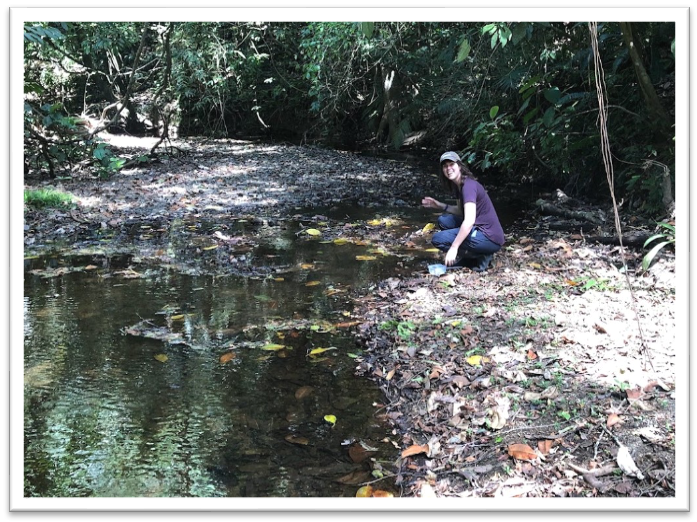
The study focused on Batrachochytrium dendrobatidis (Bd), the fungus that causes chytridiomycosis and has contributed to severe amphibian declines worldwide. Each tadpole sample was tested in three separate qPCR reactions, or wells. Most infected tadpoles carried very small amounts of the fungus, which were often detected in only one of the three wells. If the researchers had required at least two positive wells to classify a tadpole as infected, nearly two-thirds of the positive samples in the initial analysis would have been overlooked.
The researchers therefore recommend testing each sample in at least three replicate wells and considering a tadpole infected when Bd is detected in at least one of them.
Using this approach, Bd was detected in 48 of the 409 tadpoles. Infections occurred in three common stream species: the Panama cross-banded treefrog (Smilisca sila), forest toad (Rhinella alata), and rainforest rocket frog (Silverstoneia flotator). Because these tadpoles were relatively abundant and generally carried low-intensity infections, their populations could potentially help maintain the fungus in streams and act as reservoir hosts.

“Detecting these low-level infections is important because tadpoles may survive while carrying the fungus and contribute to its persistence in the environment,” said Roberto Ibáñez, director of the Panama Amphibian Rescue and Conservation Project and a coauthor of the study. “More reliable diagnosis gives us a clearer picture of disease dynamics and helps us make better-informed conservation decisions.”
The study, “Detection and Diagnosis of Low-Intensity Chytrid Fungus Infection in Tadpoles,” was authored by Kelsey Wilson, Virginie Millien, Estefany Illueca, and Roberto Ibáñez.
Wilson emphasized the broader significance of the findings: “I hope that our study can make a meaningful contribution to the field and help shed light on the importance of considering all developmental stages when studying diseases like chytrid, which affect species with complex life cycles spanning both aquatic and terrestrial habitats.”